
Plant Catalog
Coastal Trees for Philippine Resorts and Seafront Projects
Quick answer: The best coastal trees for Philippine beachfronts are Bitaog (Palo Maria), Agoho and Kalachuchi, which tolerate direct salt spray.123 Yellow Copperpod, Balitbitan, Tindalo and Molave do better one row back, behind a building or a first line of trees. Halamanan supplies the native species nursery-grown from ₱2,800 per tree as of November 2026, with a 20-tree minimum and about 1-week lead time.
Salt spray, wind and sandy soil kill most landscape trees within a season. The trees on this page come from Philippine beach forests, mangrove edges and coastal hills, or have a documented record near the sea. We rate each one by how close to the water it can go.
How close to the water? The 3 coastal zones
Coastal planting guides sort plants into 3 levels of salt tolerance.3 We use the same idea as 3 zones:
| Zone | Where it is | What it faces | What to plant |
|---|---|---|---|
| Frontline | The first row facing the sea | Direct salt spray and wind off the water | Highly salt-tolerant trees only |
| Second row | Behind a building, wall, dune or first row of trees | Some salt spray, less wind | Moderately salt-tolerant trees |
| Inland | Well back from the water | No direct salt spray | Any tree suited to the soil |
UF/IFAS describes highly salt-tolerant plants as able to handle exposed spots, moderately tolerant ones as growing best "when protected by buildings, fences, or plantings" of hardier species, and slightly tolerant ones as needing to stay well back from exposed areas.3
Coastal trees at a glance
| Tree | Native? | Frontline | Second row | Inland | Foliage | Growth | Price per tree |
|---|---|---|---|---|---|---|---|
| Bitaog (Palo Maria) | Yes | Yes | Yes | Yes | Evergreen | Slow | ₱2,800 to ₱4,200 |
| Agoho | Yes | Yes | Yes | Yes | Evergreen | Fast | ₱2,800 to ₱4,200 |
| Kalachuchi | No | Yes | Yes | Yes | Drops leaves in the dry season | Moderate | ₱2,000 to ₱14,000 |
| Yellow Copperpod (Siar) | Yes | Sheltered shores only | Yes | Yes | Deciduous | Fast | ₱2,800 to ₱4,200 |
| Balitbitan | Yes | Mangrove and river edges | Yes | Yes | Evergreen | Moderate | ₱2,800 to ₱4,200 |
| Tindalo | Yes | No | Yes | Yes | Deciduous | Slow | ₱2,800 to ₱4,200 |
| Molave | Yes | No | Yes | Yes | Deciduous | Slow | ₱2,800 to ₱4,200 |
| Royal Palm | No | No | Yes | Yes | Evergreen | Moderate | ₱13,000 to ₱38,000 |
| Canary Island Date Palm | No | No | Yes | Yes | Evergreen | Slow | ₱18,000 to ₱48,000 |
Prices are tree only, as of November 2026. Delivery and planting are quoted per project.
Frontline trees: they take the salt
Bitaog (Palo Maria)
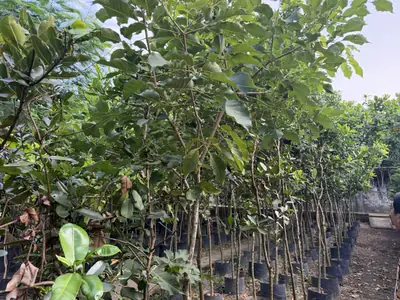
Bitaog (Calophyllum inophyllum) is a native evergreen that grows wild on sandy and rocky shores across the Philippines.1 It tolerates saline soil and salt spray,4 and grows on pure sand.5 It has glossy dark leaves and a broad, low crown that gives real shade. Its branches can be brittle in strong wind,5 so prune it early on exposed sites. See Bitaog sizes and prices →
Agoho
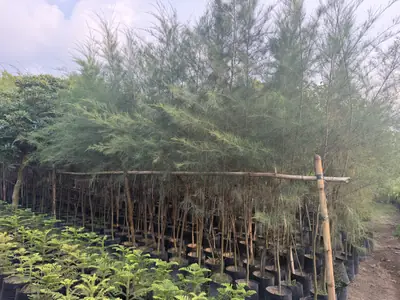
Agoho (Casuarina equisetifolia) is a pine-like native tree that grows on beach sand and tolerates salt spray and occasional seawater flooding.2 It grows fast, about 2 m a year when young,2 which makes it the quickest way to build a windbreak. Its shade is light,6 and its shallow roots can let it topple in extreme storms,7 so plant it in groups. See Agoho sizes and prices →

Kalachuchi
Kalachuchi (Plumeria) is rated salt-tolerant by UF/IFAS3 and is "fairly drought- and salt-tolerant once established".8 It's not native, but it's a long-proven flowering choice for beach gardens and pool decks. See Kalachuchi sizes and prices →
Second-row trees: plant them behind the frontline
Yellow Copperpod (Siar)
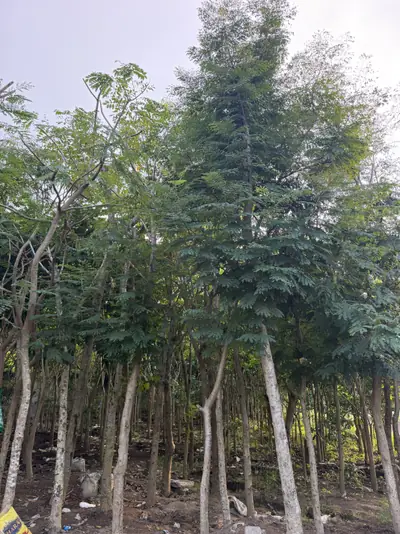
Yellow Copperpod (Peltophorum pterocarpum) is a fast-growing native with bright yellow flowers. It grows wild near beaches and mangroves.9 Sources disagree on its salt tolerance: NParks Singapore rates it tolerant,9 while UF/IFAS rates it only slightly tolerant.3 We plant it behind the frontline, where it gives a coastal avenue its color. See Yellow Copperpod sizes and prices →
Balitbitan
Balitbitan (Cynometra ramiflora) is a native evergreen shade tree that grows on the landward edge of mangroves and along rivers.10 It suits resorts by estuaries, rivers and mangroves more than open surf beaches. Its pink, drooping new leaves are its signature. See Balitbitan sizes and prices →
Tindalo
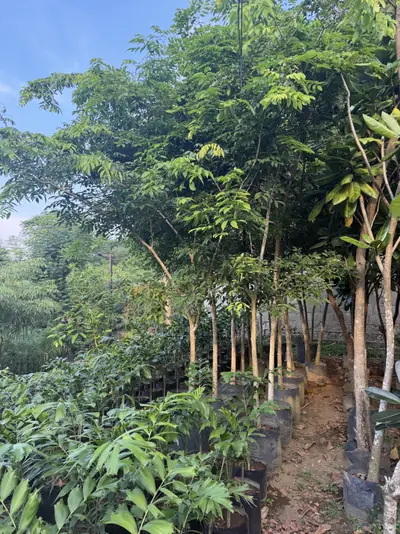
Tindalo (Afzelia rhomboidea) is a native hardwood that grows wild on low hills and ridges near the coast.11 It's classified as Endangered in the wild under DENR's 2017 list.12 Ours is nursery-grown. Plant it on coastal slopes behind the beach. See Tindalo sizes and prices →
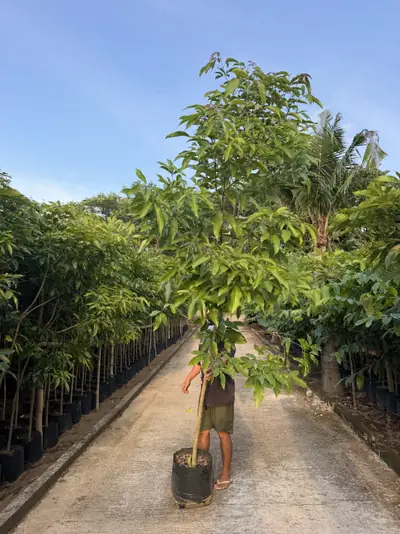
Molave
Molave (Vitex parviflora) is a native hardwood that grows on dry limestone soils and along sea coasts.13 It's slow-growing and drought-hardy. Like Tindalo, it's protected in the wild, so we supply nursery-grown stock. See Molave sizes and prices →
Royal Palm and Canary Island Date Palm
Both palms are rated moderately salt-tolerant by UF/IFAS,3 so they're best kept behind the frontline. They give resort entrances and seafront drives a formal look. Royal Palm → Canary Island Date Palm →
Trees to keep away from the beachfront
- Fire Tree (Delonix regia): UF/IFAS rates its salt-spray tolerance low in one guide14 and moderate in another,3 and its wood breaks easily.14 Keep it inland or well sheltered.
- Dita (Alstonia scholaris): no source rates its salt tolerance, so we keep it inland.
Sample coastal planting mixes
These are starting points. We adjust them to the site after a survey.
| Site | Frontline | Second row | Why it works |
|---|---|---|---|
| Beach resort | Bitaog + Agoho | Yellow Copperpod + Kalachuchi | Agoho breaks the wind fast, Bitaog adds dense evergreen shade, and the second row brings flowers |
| Seafront avenue or drive | Bitaog | Yellow Copperpod or Royal Palm | Evergreen cover by the water, color or formal palms behind it |
| River, estuary or mangrove edge | Balitbitan | Molave + Tindalo | Balitbitan handles brackish ground, and the hardwoods add long-term structure |
| Reclaimed land or sand fill | Agoho (2 staggered rows) | Bitaog | Agoho grows on bare sand and fixes its own nitrogen,2 and it shelters slower trees while they establish |
Planting on beach sand and reclaimed fill
- Mix compost into the planting hole. Pure sand drains fast. A little organic matter holds water during the first months.
- Flush the salt. On salty sites, an occasional deep watering with fresh water washes salt out of the root zone.
- Stake for the first year. Coastal wind rocks young trees and tears new roots.
- Plant in groups, not lines of singles. Trees shelter each other. A staggered double row stands up to wind far better than one row.
- Mind the drainage. Agoho and Molave don't like waterlogged ground.213 Check that the site doesn't flood for days after heavy rain.
From our own projects
We've completed several landscape projects at Peninsula de Punta Fuego in Nasugbu, Batangas, where strong winds from December to March were the main design consideration. Read how we planned a wind-tolerant tropical garden there, and see our resort and hotel landscaping service.
Coastal trees and typhoons
No tree is typhoon-proof. After Typhoon Glenda in 2014, a study at a Laguna campus recorded about 50% damage among native trees, including Bitaog, against 85% for non-native trees.15 Natives did better, but none came through untouched. On exposed coastal sites:
- Plant natives as the backbone of the planting.
- Prune early so each tree builds a strong central trunk.
- Thin crowns before the wet season (June to October).
- Keep tall trees clear of roofs, parking and power lines.
How to order
- Minimum order: 20 trees, and mixing species from our list to reach it is fine
- Lead time: about 1 week from confirmed order
- Sizes: native species come in 8-10 ft (1.5 in. caliper, ₱2,800) and 11-16 ft (2-2.5 in. caliper, ₱4,200)
- Stock: all nursery-grown in bags, with photos of your batch before delivery
- Guarantee: 30-day establishment guarantee
- Service: supply only, or supply with delivery, planting and staking
Looking for something other than coastal stock? See all our landscape trees, palms and mature trees.
Frequently Asked Questions
What trees grow best by the beach in the Philippines?
What is the most salt-tolerant native tree in the Philippines?
What trees can grow on reclaimed land or sand fill?
Which coastal trees give the most shade?
Bitaog and Balitbitan give the densest evergreen shade of the coastal trees we supply. Agoho's shade is light,6 so Agoho works better as a windbreak.
What is the best windbreak tree for the coast?
Agoho is the fastest coastal windbreak, growing about 2 m a year when young.2 Plant Agoho in staggered double rows, and back it with Bitaog for denser cover.
Can I plant Fire Tree near the beach?
Are your coastal trees native?
Of the coastal trees we supply, all are native to the Philippines except Kalachuchi, Royal Palm and Canary Island Date Palm. The native ones are Bitaog, Agoho, Yellow Copperpod, Balitbitan, Tindalo and Molave, all nursery-grown in bags.
How much do coastal trees cost?
Native coastal trees cost ₱2,800 (8-10 ft) or ₱4,200 (11-16 ft) per tree as of November 2026. Kalachuchi runs ₱2,000 to ₱14,000, Royal Palm ₱13,000 to ₱38,000 and Canary Island Date Palm ₱18,000 to ₱48,000. Delivery and planting are quoted per project.
Sources
- Philippine Guidebook on Plant Species Suitable for Urban Greening. DENR Forest Management Bureau. https://forestry.denr.gov.ph/fmb_web/wp-content/uploads/2023/06/Philippine-Guidebook-on-Plant-Species-Suitable-for-Urban-Greening-EBOOK_compressed.pdf ↩
- Agroforestree Database: Casuarina equisetifolia. World Agroforestry. https://apps.worldagroforestry.org/treedb2/AFTPDFS/Casuarina_equisetifolia.PDF ↩
- Salt-Tolerant Plants for Florida (ENH-26). Black, R. J., UF/IFAS Extension. https://ufdcimages.uflib.ufl.edu/IR/00/00/17/13/00001/EP01200.pdf ↩
- Flora & Fauna Web: Calophyllum inophyllum. National Parks Board Singapore. https://nparks.gov.sg/florafaunaweb/flora/2/7/2774 ↩
- Agroforestree Database: Calophyllum inophyllum. World Agroforestry. https://apps.worldagroforestry.org/treedb/AFTPDFS/Calophyllum_inophyllum.PDF ↩
- Some Trees Suitable for Roadside Planting in the Philippines (1953). Delizo, T., Forestry Leaves. https://repository.mainlib.upd.edu.ph/omekas/s/rare-periodicals/media/15141 ↩
- Casuarina equisetifolia, Australian Pine (FR366). UF/IFAS Extension. https://ask.ifas.ufl.edu/publication/FR366 ↩
- Plumeria. UF/IFAS Gardening Solutions. https://gardeningsolutions.ifas.ufl.edu/plants/ornamentals/plumeria/ ↩
- Flora & Fauna Web: Peltophorum pterocarpum. National Parks Board Singapore. https://www.nparks.gov.sg/florafaunaweb/flora/3/0/3056 ↩
- Cynometra ramiflora. PROSEA (Plant Resources of South-East Asia). https://prosea.prota4u.org/view.aspx?id=3436 ↩
- Afzelia (PROSEA). Pl@ntUse. https://plantuse.plantnet.org/en/Afzelia_(PROSEA) ↩
- The tree Quezon planted, and Bacolod nearly forgot (22 October 2026). Rappler. https://www.rappler.com/philippines/tindalo-tree-manuel-quezon-planted-bacolod-nearly-forgot/ ↩
- Vitex parviflora. Useful Tropical Plants. https://tropical.theferns.info/viewtropical.php?id=Vitex+parviflora ↩
- Delonix regia: Royal Poinciana (ST228). UF/IFAS Extension. https://ask.ifas.ufl.edu/publication/ST228 ↩
- Landscape improvement and maintenance using Philippine plants at Unilab PharmaCampus, Biñan City, Laguna. UPLB undergraduate thesis, University Knowledge Digital Repository. https://www.ukdr.uplb.edu.ph/etd-undergrad/5025 ↩
Planting a beachfront this season?
Send us the site plan or a few photos of the shoreline. We'll suggest a frontline and second-row mix and quote it delivered.