
Molave
Vitex parviflora
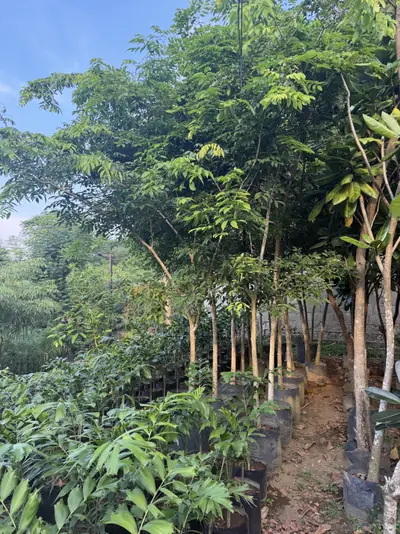
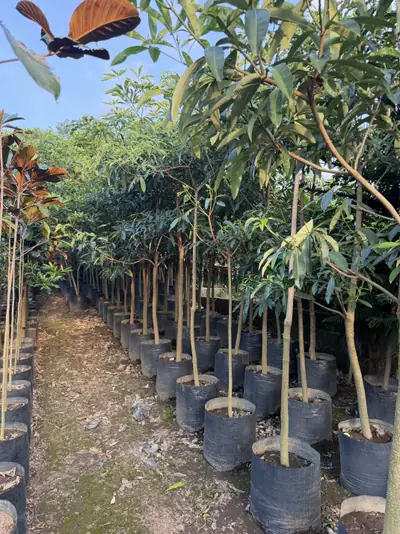
The native hardwood Filipinos have built with for centuries, from houses to Manila galleons. Molave is tough, slow-growing and drought-hardy, and it carries sprays of small blue flowers. It's now protected in the wild, so we supply it nursery-grown in bags, from 8 ft to 16 ft.
Quick answer: Molave (Vitex parviflora), or Mulawin, is a native Philippine hardwood tree prized for extremely hard, termite-resistant wood1 and classified as Endangered under DENR's 2017 threatened plants list.2 Molave is slow-growing, drought-hardy and bears small blue flowers.13 Halamanan supplies nursery-grown Molave at ₱2,800 (8-10 ft) and ₱4,200 (11-16 ft) per tree as of November 2026, with a 20-tree minimum.
Pricing Guide (per tree)
| Size / Spec | Price (PHP) |
|---|---|
| Standard, 8-10 ft | ₱2,800 |
| Large, 11-16 ft | ₱4,200 |
Final pricing depends on project volume, delivery location, and current supply. Get a project-specific quote for accurate pricing.
- Minimum order: 20 trees, and mixing species from our list to reach it is fine
- Lead time: about 1 week from confirmed order
- Prices are tree only. Delivery and planting are quoted per project.
- Caliper is the trunk width measured 6 inches above the soil.
- Prices updated: November 2026
About Molave
Molave (Vitex parviflora) is a native hardwood tree that grows wild across most of the Philippines in low-altitude forests,1 mostly where the year splits into clear wet and dry seasons.2 Molave is at home on dry limestone soils and along sea coasts.3 Its leaves come in sets of 3 glossy leaflets, and it bears many small blue flowers in sprays up to about 20 cm long.1
Molave wood is extremely hard and dense, and it resists rot and termites.1 That's why it was used for posts, flooring, furniture, boats and even Manila galleons,24 and why so many wild trees were cut down.
Common Applications
- Long-lived structure trees for campuses, parks and estate common areas
- Native-species plantings for green building, ECC and DENR replacement requirements
- Erosion control on slopes, where its roots help hold soil in place2
- Second-row coastal planting on hills and limestone ground near the sea
- Commemorative and heritage planting
Why Developers and Agencies Choose It
- It's a protected native. Planting nursery-grown Molave helps restore a species that was overharvested.2
- Agencies plant it. BCDA included Molave in its 2026 tree planting at New Clark City.6
- It's drought-hardy. Molave grows naturally on dry limestone soils with a long dry season.3
- It holds soil. Molave is used for erosion control.2
Specifications
- Botanical name
- Vitex parviflora
- Family
- Lamiaceae
- Native range
- The Philippines, Sulawesi, the Moluccas, the Lesser Sunda Islands and the Caroline Islands7
- Conservation status
- Endangered under DENR's DAO 2017-11 list.2 Legally protected in the Philippines.4
- Sizes we supply
- 8-10 ft and 11-16 ft
- Growth rate
- Slow, roughly 0.4 to 1 m a year3
- Foliage
- Deciduous. Thins out in the dry season.3
- Flowers
- Small, blue, in sprays up to 20 cm1
- Sun
- Full sun
- Water
- Low once established
- Soil
- Well-drained, including dry limestone soils3
- Salt tolerance
- Moderate. Molave grows along sea coasts,3 but isn't rated for direct salt spray.
- Pool safe
- Not ideal. Molave drops leaves in the dry season.
- Setback from structures
- At least 5 m from buildings
Molave: A National Symbol of Toughness
The name Molave comes from mulawin, the Tagalog name for the tree.1 Molave’s toughness made it a byword in Filipino culture. R. Zulueta da Costa’s poetry collection Like the Molave won the Commonwealth Literary Award for Poetry in 19405 and is still taught in schools.
Things to Know Before You Plant Molave
It thins out in the dry season
Molave is deciduous.3 If you need year-round cover, mix it with evergreen natives like Dita or Balitbitan.
It’s slow
Molave puts on well under a meter of growth a year.3 Plant the size you want to see in the next few years.
Typhoons
Molave is often recommended for typhoon-prone sites, and its wood is famously strong. We haven’t found published storm data to back that up, though. On exposed sites, stake Molave for the first year and prune early for a strong central trunk.
Is it legal to buy?
Yes, for nursery-grown stock. Molave’s protected status comes from cutting wild trees for timber. Our trees are nursery-grown in bags, as our photos show. Government agencies buy nursery-grown Molave openly for their own tree planting.6
For another protected native hardwood with a story, see Tindalo.
Planting & Establishment
Site preparation
- Dig the hole 2 to 3 times wider than the bag and no deeper than the root ball.
- Make sure the spot drains well. Molave doesn’t like standing water.
- On heavy clay, mix in compost or sand to improve drainage.
Planting
- Remove the bag carefully without breaking the root ball.
- Set the tree so the top of the root ball sits level with the ground.
- Backfill, firm the soil and water deeply.
- Stake on windy sites.
First year care
- Water 2 to 3 times a week for the first month, then weekly through the first dry season.
- Mulch around the base, keeping it off the trunk.
We handle supply, delivery, planting and staking as one job if you need it.
Ongoing Maintenance
- Pruning: Formative pruning in the first few years to keep a single strong Molave trunk.
- Fertilizing: Light feeding at the start of the wet season.
- Leaf drop: Expect leaf fall in the dry season.
We plant and install this
Halamanan supplies and installs Molave as part of our landscape design and landscape construction projects. We source the plants, place them in the design, and plant them with the rest of the garden.
Sourcing & Supply
Origin
Our Molave is nursery-grown in bags. It isn't collected from the wild.
Quality Control
Every tree is checked for form and root ball condition before it leaves the nursery. For orders of 20 or more, we send photos of the batch before delivery.
How to Order
- 1
Inquiry to Quote
Send us your specs and project size. We respond with a project-specific quote within 24 hours.
- 2
Site Visit / Spec Confirmation
For larger projects, we coordinate a site visit or spec call to confirm requirements.
- 3
Order Confirmation + Deposit
50% deposit confirms your order. Established institutional accounts may qualify for net terms.
- 4
Production / Sourcing & Delivery
We coordinate sourcing, production, and delivery. Final payment due on delivery.
- Response time
- We respond within 4 business hours.
- Payment terms
- 50/50 standard. Net terms available for established institutional accounts.
- Documentation
- Sales Invoice, Delivery Receipt, COA-compliant documentation on request.
Frequently Asked Questions
How much does a Molave tree cost in the Philippines?
A Molave tree costs ₱2,800 at 8-10 ft (1.5 in. caliper, 12 in. bag) and ₱4,200 at 11-16 ft (2-2.5 in. caliper, 18 in. bag), as of November 2026. Prices are tree only. Delivery and planting are quoted per project.
Is Molave endangered?
Is it legal to buy and plant Molave?
Yes, when the Molave is nursery-grown. Our Molave is grown in bags at a nursery, not dug from the wild. Government agencies also buy nursery-grown Molave for their planting programs.6
Is Molave the same as Mulawin?
Yes. "Molave" comes from mulawin, the Tagalog name for the same tree.1
Is Molave native to the Philippines?
Yes. Molave is native to the Philippines: Kew's Plants of the World Online lists the Philippines in its native range.7
Is Molave invasive?
Not in the Philippines, where Molave is native. Molave has escaped cultivation in Guam and Hawaii, where it was introduced.4
Does Molave lose its leaves?
Yes. Molave thins out in the dry season.3 Mix it with evergreen trees if you need year-round cover.
How fast does Molave grow?
Slowly. Molave grows roughly 0.4 to 1 m a year.3
What's the minimum order for Molave?
Molave orders start at 20 trees. You can mix Molave with other species on our list to reach the 20.
How long does Molave delivery take?
Molave delivery takes about 1 week from confirmed order, depending on your location.
What does your 30-day establishment guarantee cover?
The 30-day establishment guarantee covers nursery-side failures on every Molave tree we supply. If a properly installed tree (planted by us or per our written planting protocol) fails within 30 days because of root ball damage, undisclosed disease or transport stress, we replace it free. Failures from improper post-planting care, weather events or vandalism are not covered.
Sources
- Mulawin: Vitex parviflora. StuartXchange. https://stuartxchange.org/Mulawin ↩
- Arboretum of 101 Threatened Philippine Trees: Molave entry. Ateneo de Manila University. https://cms-training.ateneo.edu/ais/arboretum-101-threatened-native-trees ↩
- Vitex parviflora. Useful Tropical Plants. https://tropical.theferns.info/viewtropical.php?id=Vitex+parviflora ↩
- Vitex parviflora. Wikipedia. https://en.wikipedia.org/wiki/Vitex_parviflora ↩
- R. Zulueta da Costa. Wikipedia. https://en.wikipedia.org/wiki/R._Zulueta_da_Costa ↩
- Procurement of Planting Materials for the BCDA 2026 Tree Planting Activities in New Clark City (RFQ, July 2026). BCDA via PhilGEPS. https://www.bcda.gov.ph/sites/default/files/2026-07/PhilGEPS%20PR0002472.pdf ↩
- Plants of the World Online: Vitex parviflora. Royal Botanic Gardens, Kew. https://powo.science.kew.org/taxon/urn:lsid:ipni.org:names:865916-1 ↩
Ready to spec Molave for your project?
Send us your project details. We respond within 4 business hours.