
Yellow Copperpod (Siar)
Peltophorum pterocarpum
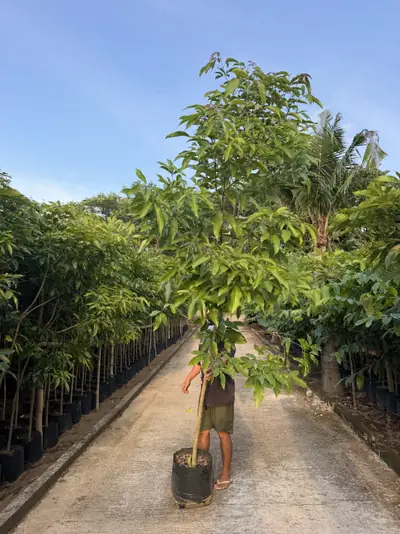
A native, fast-growing shade tree that covers its crown in bright yellow flowers, followed by copper-red pods. Yellow Copperpod grows wild near beaches and mangroves, and it's one of the most planted avenue trees in Southeast Asia. We supply it nursery-grown in bags, from 8 ft to 16 ft.
Quick answer: Yellow Copperpod or Siar (Peltophorum pterocarpum) is a fast-growing native Philippine tree with bright yellow flowers and copper-red pods.12 Yellow Copperpod grows wild near beaches and mangroves,1 so it works as an avenue tree and in the second row of a coastal planting. Halamanan supplies nursery-grown Yellow Copperpod at ₱2,800 (8-10 ft) and ₱4,200 (11-16 ft) per tree as of November 2026, with a 20-tree minimum.
Pricing Guide (per tree)
| Size / Spec | Price (PHP) |
|---|---|
| Standard, 8-10 ft | ₱2,800 |
| Large, 11-16 ft | ₱4,200 |
Final pricing depends on project volume, delivery location, and current supply. Get a project-specific quote for accurate pricing.
- Minimum order: 20 trees, and mixing species from our list to reach it is fine
- Lead time: about 1 week from confirmed order
- Prices are tree only. Delivery and planting are quoted per project.
- Caliper is the trunk width measured 6 inches above the soil.
- Prices updated: November 2026
About Yellow Copperpod
Yellow Copperpod (Peltophorum pterocarpum) is a native medium to large tree with an umbrella-shaped crown and fine, feathery leaves.1 When Yellow Copperpod blooms, upright clusters of bright yellow flowers cover the canopy. Each crinkled petal has orange stamens and a reddish-brown mark at its center.1 The flowers give way to flat, winged pods that start copper-red and turn brown-black,1 which is where the name "copperpod" comes from.
In the wild, Yellow Copperpod grows in coastal forest, mangroves and on sandy beaches, and it tolerates saline soil and salt spray.1 It grows fast: about 9 m in 3 years, flowering at around 4 years old.2
Yellow Copperpod is a proven city tree. Singapore started planting it for shade in 1936, and by 2009 it was the second most common tree in the country's managed parks and streets, at more than 25,000 trees.3
Common Applications
- Avenue and street planting, for a uniform yellow bloom along a road
- Second-row coastal planting at resorts, behind Bitaog or Agoho
- Shade over lawns, parks and large gathering areas
- Shelterbelts and windbreaks2
- Quick shade on new developments, thanks to its fast growth
Why Developers and Resorts Choose It
- It's native and salt-tolerant. Yellow Copperpod is one of the few flowering avenue trees that also grows on beaches.1
- It's fast. Yellow Copperpod reaches useful shade size in a few years.2
- It flowers heavily. A planted avenue turns yellow in bloom, without using a non-native like Fire Tree.
- Agencies plant it. BCDA included Siar in its 2026 tree planting at New Clark City.4
Specifications
- Botanical name
- Peltophorum pterocarpum
- Family
- Fabaceae
- Native range
- Thailand, Vietnam, Cambodia, Malaysia, Borneo, Sumatra, Java, Sulawesi, the Philippines, New Guinea and northern Australia5
- Sizes we supply
- 8-10 ft and 11-16 ft
- Mature height
- Usually 15 to 24 m2
- Crown
- Umbrella-shaped, 9 to 12 m wide1
- Growth rate
- Fast2
- Foliage
- Deciduous1
- Flowers
- Bright yellow, in upright clusters1
- Sun
- Full sun
- Soil
- Free-draining soils. Also tolerates clay.2
- Salt tolerance
- Moderate to high. NParks Singapore rates it tolerant of saline soil and salt spray,1 but UF/IFAS rates it only slightly salt-tolerant.7 Plant it behind the frontline on open beaches.
- Pool safe
- Not ideal. Yellow Copperpod drops flowers, leaflets and pods.
- Setback from structures
- At least 3 m from paving6 and 5 m from buildings
Coastal Planting: Where Yellow Copperpod Fits
| Zone | What it faces | Yellow Copperpod |
|---|---|---|
| Frontline | Direct salt spray and wind off the water | Sheltered shores only. Sources disagree on its salt tolerance.17 |
| Second row | Behind a building, wall or first row of trees | Yes |
| Inland | No salt spray | Yes |
Yellow Copperpod is the flowering option in a coastal mix. Plant it behind Bitaog and Agoho, which take the salt and wind in front. For the full list, see our coastal trees by zone.
Things to Know Before You Plant Yellow Copperpod
Typhoons and roots
Sources disagree here. World Agroforestry calls Yellow Copperpod wind firm and notes it’s used in shelterbelts.2 UF/IFAS warns that its shallow surface roots can let it blow over in hurricane-force winds.6 It handles normal wind, but give it room for its roots and stake it while young. Plant it about 3 m from sidewalks and paving, since surface roots can lift them.6
It thins out in the dry season
Yellow Copperpod is deciduous.1 In an avenue, that means a short bare spell each year before the new leaves and flowers come.
Pruning on streets
Along roads, Yellow Copperpod needs regular pruning to keep branches clear of traffic.1
Planting & Establishment
Site preparation
- Dig the hole 2 to 3 times wider than the bag and no deeper than the root ball.
- Make sure the spot drains well.
- On beach sand, mix in a little compost to hold water during establishment.
Planting
- Remove the bag carefully without breaking the root ball.
- Set the tree so the top of the root ball sits level with the ground.
- Backfill, firm the soil and water deeply.
- Stake for the first year, especially on exposed sites.
Spacing
- Avenue: about 8 to 10 m apart, so the crowns meet as they mature
- From paving: at least 3 m6
First year care
- Water 2 to 3 times a week for the first month, then weekly through the dry season.
- On salty sites, an occasional deep watering with fresh water flushes salt from the root zone.
We handle supply, delivery, planting and staking as one job if you need it.
Ongoing Maintenance
- Pruning: Formative pruning while young. On streets, keep Yellow Copperpod branches clear of traffic.1 Keep side branches smaller than half the trunk’s width for better wind resistance.6
- Fertilizing: Rarely needed. As a legume, Yellow Copperpod needs little.
- Pests: Usually minor. Leaf-eating caterpillars and beetles show up occasionally.2
- Litter: Expect fallen flowers, leaflets and pods.
We plant and install this
Halamanan supplies and installs Yellow Copperpod as part of our landscape design and landscape construction projects. We source the plants, place them in the design, and plant them with the rest of the garden.
Sourcing & Supply
Origin
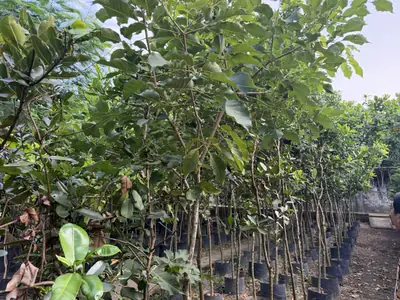
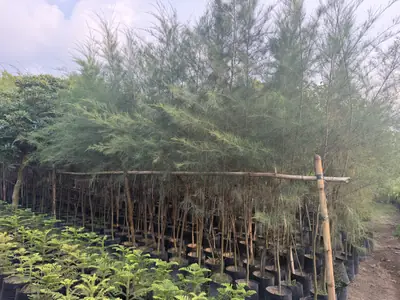
Our Yellow Copperpod is nursery-grown in bags. It isn't collected from the wild.
Quality Control
Every tree is checked for form and root ball condition before it leaves the nursery. For avenue orders, we pick trees of matching size and form, and send photos of the batch before delivery.
How to Order
- 1
Inquiry to Quote
Send us your specs and project size. We respond with a project-specific quote within 24 hours.
- 2
Site Visit / Spec Confirmation
For larger projects, we coordinate a site visit or spec call to confirm requirements.
- 3
Order Confirmation + Deposit
50% deposit confirms your order. Established institutional accounts may qualify for net terms.
- 4
Production / Sourcing & Delivery
We coordinate sourcing, production, and delivery. Final payment due on delivery.
- Response time
- We respond within 4 business hours.
- Payment terms
- 50/50 standard. Net terms available for established institutional accounts.
- Documentation
- Sales Invoice, Delivery Receipt, COA-compliant documentation on request.
Frequently Asked Questions
How much does a Yellow Copperpod tree cost in the Philippines?
A Yellow Copperpod tree costs ₱2,800 at 8-10 ft (1.5 in. caliper, 12 in. bag) and ₱4,200 at 11-16 ft (2-2.5 in. caliper, 18 in. bag), as of November 2026. Prices are tree only. Delivery and planting are quoted per project.
Is Yellow Copperpod the same as Siar?
Is Yellow Copperpod native to the Philippines?
Yes. Yellow Copperpod is native to the Philippines: Kew's Plants of the World Online lists the Philippines in its native range.5
Can Yellow Copperpod be planted by the beach?
Is Yellow Copperpod a good alternative to Fire Tree?
How fast does Yellow Copperpod grow?
Fast. Yellow Copperpod can reach about 9 m in 3 years and starts flowering at around 4 years.2
Will Yellow Copperpod roots damage paving?
They can. Yellow Copperpod has shallow surface roots, so plant it about 3 m from sidewalks and paving.6
What's the minimum order for Yellow Copperpod?
Yellow Copperpod orders start at 20 trees. You can mix Yellow Copperpod with other species on our list to reach the 20.
How long does Yellow Copperpod delivery take?
Yellow Copperpod delivery takes about 1 week from confirmed order, depending on your location.
What does your 30-day establishment guarantee cover?
The 30-day establishment guarantee covers nursery-side failures on every Yellow Copperpod tree we supply. If a properly installed tree (planted by us or per our written planting protocol) fails within 30 days because of root ball damage, undisclosed disease or transport stress, we replace it free. Failures from improper post-planting care, weather events or vandalism are not covered.
Sources
- Flora & Fauna Web: Peltophorum pterocarpum. National Parks Board Singapore. https://www.nparks.gov.sg/florafaunaweb/flora/3/0/3056 ↩
- Agroforestree Database: Peltophorum pterocarpum. World Agroforestry. https://apps.worldagroforestry.org/treedb/AFTPDFS/Peltophorum_pterocarpum.PDF ↩
- Peltophorum pterocarpum. Urban Forest Singapore (uforest.org). https://uforest.org/Species/P/Peltophorum_pterocarpum.php ↩
- Procurement of Planting Materials for the BCDA 2026 Tree Planting Activities in New Clark City (RFQ, July 2026). BCDA via PhilGEPS. https://www.bcda.gov.ph/sites/default/files/2026-07/PhilGEPS%20PR0002472.pdf ↩
- Plants of the World Online: Peltophorum pterocarpum. Royal Botanic Gardens, Kew. https://powo.science.kew.org/taxon/urn:lsid:ipni.org:names:513021-1 ↩
- Peltophorum pterocarpum: Yellow Poinciana (ST434). UF/IFAS Extension. https://edis.ifas.ufl.edu/publication/st434 ↩
- Salt-Tolerant Plants for Florida (ENH-26). Black, R. J., UF/IFAS Extension. https://ufdcimages.uflib.ufl.edu/IR/00/00/17/13/00001/EP01200.pdf ↩
Ready to spec Yellow Copperpod for your project?
Send us your project details. We respond within 4 business hours.