
Bitaog (Palo Maria)
Calophyllum inophyllum
The native seaside tree of the Philippines. Bitaog grows wild on sandy and rocky shores across the archipelago and handles salt spray that most landscape trees can't. We supply it nursery-grown in bags, from 8 ft to 16 ft, for beach resorts, coastal estates and seafront developments.
Quick answer: Bitaog (Calophyllum inophyllum), also called Palo Maria, is a native Philippine seaside tree that tolerates salt spray and sandy soil,1 which makes it a top pick for beach resorts and coastal estates. Halamanan supplies nursery-grown Bitaog at ₱2,800 (8-10 ft) and ₱4,200 (11-16 ft) per tree as of November 2026, with a 20-tree minimum and about 1-week lead time.
Pricing Guide (per tree)
| Size / Spec | Price (PHP) |
|---|---|
| Standard, 8-10 ft | ₱2,800 |
| Large, 11-16 ft | ₱4,200 |
Final pricing depends on project volume, delivery location, and current supply. Get a project-specific quote for accurate pricing.
- Minimum order: 20 trees, and mixing species from our list to reach it is fine
- Lead time: about 1 week from confirmed order
- Prices are tree only. Delivery and planting are quoted per project.
- Caliper is the trunk width measured 6 inches above the soil.
- Prices updated: November 2026
About Bitaog
Bitaog (Calophyllum inophyllum) is a native medium to large evergreen tree with thick, glossy, dark green leaves and a broad, low-branching crown. DENR's urban greening guidebook describes Bitaog as growing naturally on shorelines across the archipelago and highly tolerant of salt spray, sandy soil and windy sites.1 It's slow-growing, so the size you plant is close to the size you'll have for the first few years.2
Bitaog's small white flowers are sweet-scented but only last about a day.2 The fruit is a round green ball, 2 to 4 cm across, that floats. That's how the species spread along Pacific and Indian Ocean coasts.2
Common Applications
- Frontline beach planting at resorts and private beach lots
- Seafront avenues and boardwalks
- Shade for coastal parking and gathering areas
- Windbreak rows behind a beach, as the first line that protects less hardy plants
- Reclaimed and sand-fill sites
Why Developers and Resorts Choose It
- It handles salt spray. NParks Singapore lists Bitaog as tolerant of saline soils and salt spray.2
- It grows on sand. The species "will thrive on pure sand" near the coast.3
- It's native. Bitaog fits native-species requirements in green building briefs and permit conditions.
- It's evergreen. Bitaog doesn't go bare in the dry season the way Molave or Banaba do.
Specifications
- Botanical name
- Calophyllum inophyllum
- Family
- Calophyllaceae
- Local names
- Bitaog, Palo Maria. Also called Tamanu and Alexandrian laurel abroad.
- Native range
- East Africa and the Indian Ocean through tropical Asia, including the Philippines, to the Pacific5
- Sizes we supply
- 8-10 ft and 11-16 ft
- Growth rate
- Slow
- Sun
- Full sun
- Water
- Moderate. Water regularly until established.
- Soil
- Sandy to loamy, well drained. Thrives on beach sand.
- Salt tolerance
- High (salt spray and saline soil)
- Pool safe
- Not ideal right beside a pool. Bitaog drops leaves and round fruits.
- Setback from structures
- At least 4 m from buildings and paving
Coastal Planting: Where Bitaog Fits
Coastal trees fall into 3 zones. Bitaog is one of the few that works in all of them.
| Zone | What it faces | Bitaog |
|---|---|---|
| Frontline | Direct salt spray and wind off the water | Yes |
| Second row | Behind a building, wall or first row of trees | Yes |
| Inland | No salt spray | Yes |
For a mixed coastal planting, put Bitaog and Agoho in the frontline. Shelter less tolerant trees like Molave and Tindalo behind them, with Balitbitan in the second row for shade.
A note on typhoons
Bitaog holds up well to salt, but its branches can be brittle in strong wind.3 After Typhoon Glenda in 2014, a study at a Laguna campus recorded about 50% damage among the native trees there, including Bitaog, against 85% for the non-native trees.4 Natives did better, but none came through untouched. For exposed sites we recommend:
- Structural pruning early, so it develops a strong central trunk and well-spaced branches
- Staking for the first year
- Keeping the crown thinned before typhoon season (June to October)
Planting & Establishment
Site preparation
- Dig the hole 2 to 3 times wider than the bag and no deeper than the root ball.
- On pure sand or reclaimed fill, mix in compost or garden soil to hold water during establishment.
- Check drainage. Bitaog doesn’t like standing water around the roots.
Planting
- Remove the bag carefully without breaking the root ball.
- Set the tree so the top of the root ball sits level with the ground.
- Backfill, firm the soil and water deeply.
- Stake on exposed or windy sites.
First year care
- Water 2 to 3 times a week for the first month, then weekly through the dry season.
- On salty sites, an occasional deep watering with fresh water flushes salt from the root zone.
- Mulch around the base, keeping it off the trunk.
We handle supply, delivery, planting and staking as one job if you need it.
Ongoing Maintenance
- Pruning: Formative pruning in the first 2 to 3 years. Thin the Bitaog crown before typhoon season.
- Fertilizing: Light feeding at the start of the wet season. Bitaog doesn’t need much.
- Pests: Insects can feed on new leaves and shoots.3 Usually cosmetic on established trees.
- Leaf and fruit drop: Expect fallen leaves and round fruits under the crown. Plan for cleanup around paths and pools.
- Safety: Bitaog fruit and seeds aren’t for eating. The leaves contain saponin and hydrocyanic acid.3
We plant and install this
Halamanan supplies and installs Bitaog as part of our landscape design and landscape construction projects. We source the plants, place them in the design, and plant them with the rest of the garden.
Sourcing & Supply
Origin
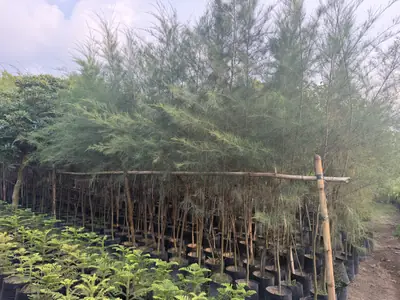
Our Bitaog is nursery-grown in bags from seed. It isn't collected from the wild. You can see it in the photos: wild-dug trees are field-dug and far bigger.
Quality Control
Every tree is checked for form and root ball condition before it leaves the nursery. For orders of 20 or more, we send photos of the batch before delivery.
How to Order
- 1
Inquiry to Quote
Send us your specs and project size. We respond with a project-specific quote within 24 hours.
- 2
Site Visit / Spec Confirmation
For larger projects, we coordinate a site visit or spec call to confirm requirements.
- 3
Order Confirmation + Deposit
50% deposit confirms your order. Established institutional accounts may qualify for net terms.
- 4
Production / Sourcing & Delivery
We coordinate sourcing, production, and delivery. Final payment due on delivery.
- Response time
- We respond within 4 business hours.
- Payment terms
- 50/50 standard. Net terms available for established institutional accounts.
- Documentation
- Sales Invoice, Delivery Receipt, COA-compliant documentation on request.
Frequently Asked Questions
How much does a Bitaog tree cost in the Philippines?
A Bitaog tree costs ₱2,800 at 8-10 ft (1.5 in. caliper, 12 in. bag) and ₱4,200 at 11-16 ft (2-2.5 in. caliper, 18 in. bag), as of November 2026. Prices are tree only. Delivery and planting are quoted per project.
Is Bitaog the same as Palo Maria?
Yes. Bitaog and Palo Maria are 2 local names for the same tree, Calophyllum inophyllum. Outside the Philippines it's often called Tamanu or Alexandrian laurel.
Is Bitaog native to the Philippines?
Can Bitaog be planted right on the beach?
Yes. Bitaog is one of the most salt-tolerant trees available in the Philippines and grows wild on sandy and rocky shores.1 Fresh-water watering during the first months helps it establish.
Will Bitaog survive a typhoon?
Bitaog is tougher than most landscape trees, but its branches can be brittle in strong wind.3 Early structural pruning, staking for the first year and crown thinning before the wet season make a big difference.
How fast does Bitaog grow?
Slowly.2 Plant the Bitaog size you want to see in the next few years, rather than a small tree you expect to fill in quickly.
What's the minimum order for Bitaog?
Bitaog orders start at 20 trees. You can mix Bitaog with other species on our list to reach the 20.
How long does Bitaog delivery take?
Bitaog delivery takes about 1 week from confirmed order, depending on your location.
Are your Bitaog trees wild-collected?
No. Our Bitaog trees are nursery-grown in bags from seed.
Is Bitaog fruit edible?
No. Don't eat Bitaog fruit or seeds. The leaves also contain saponin and hydrocyanic acid,3 so don't let fallen leaves pile up in fish ponds.
What does your 30-day establishment guarantee cover?
The 30-day establishment guarantee covers nursery-side failures on every Bitaog tree we supply. If a properly installed tree (planted by us or per our written planting protocol) fails within 30 days because of root ball damage, undisclosed disease or transport stress, we replace it free. Failures from improper post-planting care, weather events or vandalism are not covered.
Sources
- Philippine Guidebook on Plant Species Suitable for Urban Greening. DENR Forest Management Bureau. https://forestry.denr.gov.ph/fmb_web/wp-content/uploads/2023/06/Philippine-Guidebook-on-Plant-Species-Suitable-for-Urban-Greening-EBOOK_compressed.pdf ↩
- Flora & Fauna Web: Calophyllum inophyllum. National Parks Board Singapore. https://nparks.gov.sg/florafaunaweb/flora/2/7/2774 ↩
- Agroforestree Database: Calophyllum inophyllum. World Agroforestry. https://apps.worldagroforestry.org/treedb/AFTPDFS/Calophyllum_inophyllum.PDF ↩
- Landscape improvement and maintenance using Philippine plants at Unilab PharmaCampus, Biñan City, Laguna. UPLB undergraduate thesis. https://www.ukdr.uplb.edu.ph/etd-undergrad/5025 ↩
- Plants of the World Online: Calophyllum inophyllum. Royal Botanic Gardens, Kew. https://powo.science.kew.org/taxon/urn:lsid:ipni.org:names:427190-1 ↩

Ready to spec Bitaog for your project?
Send us your project details. We respond within 4 business hours.