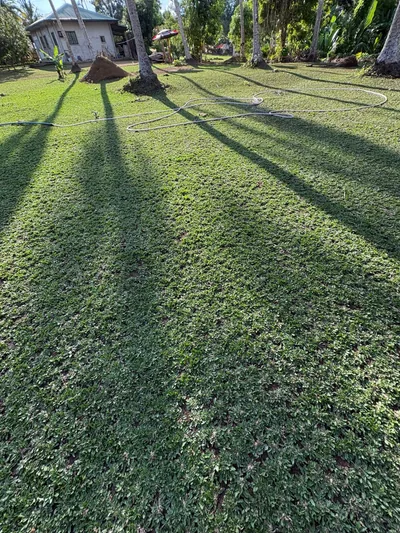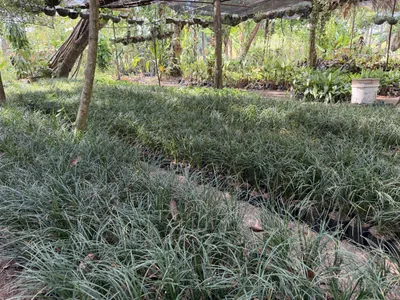
Blue Grass
Zoysia matrella
Also known as: Manila Grass, Korean Grass, Zoysia
The fine, dark green flat-lawn zoysia that PH landscapers sell as 'blue grass.' Not blue fescue, not Kentucky bluegrass. Identified as Zoysia matrella (Manila grass), native to the Philippines, salt-tolerant, and denser underfoot than bermuda. ₱180/sqm, dropping to ₱150/sqm above 10 sqm. We confirm the grass by leaf and sod sample before you commit, because PH trade names slip.
Pricing Guide (per sqm)
| Size / Spec | Price (PHP) |
|---|---|
| 1-10 sqm | ₱180 |
| More than 10 sqm | ₱150 |
Volume Discounts
- 11+ sqm:₱150/sqm (from ₱180/sqm)
Prices reflect turf (plant material) only, sold per square meter. Orders above 10 sqm are charged at ₱150/sqm. Soil preparation, delivery, and installation (laying and rolling) are quoted per project based on site access and ground condition. Zoysia is slow to knit in, so budget for weed control during the establishment window. We confirm the grass by leaf and sod sample before delivery.
Request Project Quote →About Blue Grass
In the Philippines, 'blue grass' is a fine, dense, dark green warm-season lawn turf sold by the square meter. It is not the silver-blue ornamental blue fescue (Festuca glauca), and not the temperate Kentucky bluegrass (Poa pratensis) of US and European lawns, both of which fail in PH lowland heat. The PH 'blue grass' is best identified as Zoysia matrella (Manila grass), a fine zoysia whose native range explicitly includes the Philippines per Plants of the World Online (Royal Botanic Gardens, Kew).[^1] It forms a tight, cushiony, weed-resistant carpet, tolerates salt and light shade better than bermuda, and grows slowly so it needs less mowing. We lead the species identification plainly and confirm any batch by leaf and sod sample, because PH turf trade names ('blue grass', 'Korean grass', 'Manila grass') overlap and no two sellers use them identically.
Common Applications
- Residential lawns wanting a fine, manicured look. The upgrade from coarse carabao grass and the finer, denser alternative to bermuda for premium front and back lawns.
- Subdivision common areas and amenity lawns. Clubhouse, pocket-park, and common-area turf where a refined, low-mow finish matters.
- Resort and hotel grounds. Manicured grounds and event lawns where appearance and density carry the landscape.
- Golf fairways and tee areas. Zoysia is a classic golf turf, valued for density and wear resistance underfoot.
- Slopes, embankments, and erosion control. Dense stolon-and-rhizome mat holds soil on road embankments and graded banks.
- Coastal and near-shore lawns. Salt tolerance suits beachfront and near-shore residential and resort lawns where most turf struggles.
Where You'll See It
- Premium subdivision front and back lawns
- Clubhouse, amenity, and common-area turf
- Resort and hotel manicured grounds
- Golf course fairways and tee boxes
- Road embankments and graded slopes (erosion control)
- Coastal and near-shore residential lawns
Why Architects Choose It
- PH-native species (Zoysia matrella per POWO): supports native-spec and biodiversity briefs
- Finer and denser than bermuda: a clear visual upgrade over carabao grass
- Slow-growing: less frequent mowing than bermuda
- Salt-tolerant: extends turf specification into coastal sites
- More shade-tolerant than bermuda, while still preferring full sun
- Tough, wear-resistant turf that handles foot traffic
Project Types Best Suited
- Premium residential landscaping
- Subdivision and amenity common areas
- Hotel and resort grounds
- Golf course turf
- Slope and embankment erosion control
- Coastal residential and resort lawns
Specifications
- Botanical name
- Zoysia matrella (L.) Merr.
- Family
- Poaceae (grass family)
- Genus
- Zoysia (named for 18th-century Austrian botanist Karl von Zois)
- PH trade names
- Blue grass, Korean grass, Manila grass (names overlap; confirm by leaf)
- Native range
- Includes the Philippines per POWO; broader tropical/subtropical Asia to the Pacific
- Status in PH
- Native species (per POWO); 'Manila grass' was first exported as seed from Manila in 1911
- Habit
- Warm-season perennial turf grass; spreads by stolons and rhizomes into a dense flat mat
- Form sold
- Lawn turf by the square meter, as squares or rolls (propagated by sod/plugs/sprigs, not seed)
- Blades
- Fine, narrow, sharp-pointed; denser and finer than bermuda; deep to dark green with a possible grey-green cast
- Mown height
- Best kept short, roughly 2.5-4 cm (1-1.5 in); reel mower gives the cleanest cut
- Growth rate
- Slow (less frequent mowing; slower to establish than bermuda)
- Sun
- Full sun ideal; tolerates light shade better than bermuda
- Water
- Moderate; drought-tolerant once established; deep infrequent watering preferred
- Soil
- Adaptable; prefers well-drained; tolerates sandy soils
- Salt tolerance
- High; suits coastal and near-shore lawns and erosion control
- Foot traffic
- Tough and wear-resistant; handles foot traffic well (golf and lawn use)
- Dormancy
- Warm-season; can brown off and go semi-dormant in cool or very dry spells, greens back with warmth. Stays green most of the year in PH lowlands
- Pool safe
- Yes (fine, low-litter turf)
Blue Grass (Zoysia matrella) Turf Supplier in the Philippines
In the Philippines, “blue grass” is a fine, dense, dark green lawn turf, sold by the square meter for premium lawns. It is best identified as Zoysia matrella (Manila grass), a warm-season zoysia whose native range explicitly includes the Philippines.1 It forms a tight, cushiony, weed-resistant carpet that is finer and denser than bermuda and a clear upgrade over coarse carabao grass.
We supply it at ₱180 per square meter, dropping to ₱150 per square meter above 10 sqm, and we confirm the grass by leaf and sod sample before you commit, because PH turf trade names slip.
What “Blue Grass” Is NOT
Three different plants get called some form of “blue grass.” Only one is what PH landscapers actually sell:
- Kentucky bluegrass (Poa pratensis). The classic temperate lawn turf of the US and Europe. Cool-season. It does not hold up in Philippine lowland heat. Not what is sold here.
- Blue fescue (Festuca glauca). The silver-blue clumping ornamental “blue grass” of garden centers abroad. Cool-season, forms tidy mounds, struggles in PH humidity. Not a PH lawn.
- PH “blue grass.” A warm-season lawn turf, fine-bladed, dense, sold by the square meter. This is the one, and it has nothing to do with the two above.
So if you searched “blue grass” expecting the silver-blue ornamental, that is a different plant. In the Philippines, blue grass is a fine lawn grass.
The PH Trade-Name Tangle (Buyer Beware)
Philippine turf vernacular is loose and inconsistent. The same grass carries several names, and the same name covers different grasses depending on the seller:
| Trade name | What it usually means | Watch out for |
|---|---|---|
| Blue grass | The fine, flat zoysia lawn (this product) | The name itself is undocumented; confirm by leaf |
| Korean grass | Often the same fine zoysia, sometimes a “finer grade” | Also used for the mounding ornamental Z. pacifica |
| Manila grass | Zoysia matrella proper | The most defensible botanical name for the lot |
Net: “blue grass,” “Korean grass,” and “Manila grass” all circle the fine-zoysia turf category, but no two sellers use them identically. The flat, fine lawn form is what separates blue grass from the puffy mounding ornamental immediately. The honest rule for buyers: confirm the grass by leaf texture and an actual sod sample, not by the name. We identify by species and show you the blade before you commit.
Botanical Identity
The fine PH lawn zoysia is, most defensibly, Zoysia matrella (Manila grass). The accepted name is Zoysia matrella (L.) Merr. per Plants of the World Online,1 and its native range explicitly includes the Philippines. Family Poaceae; genus Zoysia, named for 18th-century Austrian botanist Karl von Zois.
“Blue grass” names a tangled complex, not one clean species, so it is worth explaining the complex rather than fighting over a single binomial:
- Flat creeping lawn form = Zoysia matrella. Fine, dense, dark green, flat. This is PH “blue grass” as a lawn. Native to the Philippines, salt-tolerant, low-light tolerant, slow-growing.
- Puffy mounding ornamental = Zoysia pacifica (the old “tenuifolia”). Forms raised hummocks, used as a no-mow ornamental (“Korean velvet grass,” “Mascarene grass”). Essentially absent from PH turf trade, sold abroad as a potted specialty for rockeries and Japanese-style gardens. Treat it as a separate, non-lawn product.2
- Coarser cousin = Zoysia japonica (Korean / Japanese lawngrass). Wider, lighter-green blades, temperate East Asia native, not PH-native.3
Why some sites say “tenuifolia.” “Korean grass” is a documented common name for the tenuifolia ornamental, and some seed sellers market “Zoysia tenuifolia Blue Grass Seeds” outright. That does not contradict the matrella reading: the authorities fold tenuifolia into Z. matrella anyway (NC State treats it as a synonym; POWO places the fine ornamental under Z. pacifica). So “blue grass = tenuifolia” and “blue grass = matrella” are two labels for one entangled group, not rival answers. The distinction that actually matters is habit, not the binomial: if it lays flat as an even lawn, it is blue grass; if it mounds into puffs, it is the ornamental.
The Philippine-Native Angle
As Zoysia matrella, blue grass is a genuine PH-native species, not an introduced one. The common name “Manila grass” comes straight from Manila: the grass was first exported as seed from Manila in 1911 by the US Bureau of Plant Industry and named for the city. USDA botanist C.V. Piper described Z. matrella (collected from the Philippines, 1911-1912) as “abundant near the seashore in the Philippine Islands,” noting that “where closely clipped it makes a beautiful lawn” and that it had gradually displaced bermudagrass. That is effectively a period description of this exact product: a fine Philippine zoysia that makes a tight clipped lawn and outcompetes bermuda on looks.
How to Confirm It by Eye
Since no article maps PH “blue grass” to a species for you, use these tells to verify a batch is the fine Manila-grass zoysia, not a look-alike:
- vs the mounding ornamental (Z. pacifica / tenuifolia): matrella grows as a flat, even lawn; pacifica forms raised puffy hummocks and needle tufts. If it mounds, it is not blue grass.
- vs bermuda (Cynodon dactylon): matrella blades are stiffer, sharper, finer; the turf is denser and more cushioned underfoot. Bermuda has softer blades, obvious surface runners, and recovers faster.
- vs carabao grass (Axonopus compressus): no contest. Carabao is broad, coarse, light green; matrella is fine and dark green.
- vs coarser Korean / Japanese lawngrass (Z. japonica): japonica blades are wider and lighter green; matrella is finer and darker.
- General matrella tells: very fine dark-green blades with a sharp point, extremely dense knit, slow spread, tough underfoot; browns off in cool or very dry spells and recovers with warmth.
Form and Texture
- Fine, narrow, pointy blades, denser and finer than bermuda, forming a tight, cushiony, carpet-like turf.
- Deep to dark green. The “blue” in “blue grass” is most likely the bluish or grey-green cast fine zoysia can show, but no source states the name’s origin outright, so treat that as a reasonable guess rather than a fact.
- Spreads by both stolons and rhizomes, knitting into a dense mat that resists weeds once closed.
- Slow-growing, which means less frequent mowing.
- Warm-season: it can brown off and go semi-dormant in cool or very dry spells and greens back with warmth and water. In PH lowlands it stays green most of the year.
Growing Conditions in the Philippines
- Sun: full sun is ideal; tolerates light shade better than bermuda. More sun, denser turf.
- Water: moderate; drought-tolerant once established. Deep, infrequent watering beats frequent shallow watering.
- Soil: adaptable; prefers well-drained soil; tolerates sandy soils.
- Salt: salt-tolerant, suiting coastal and near-shore lawns and erosion control, a real advantage over many turfs.
- Traffic: forms a tough, wear-resistant turf; handles foot traffic well, which is why it is used on golf courses and lawns.
- Establishment: by sod (squares or rolls), plugs, or sprigs, not usually by seed in PH practice. Slow to establish and to knit in compared to bermuda, so expect patience and weed control during fill-in.
Lawn Use in the Philippines
- Residential lawns where a fine, manicured look is wanted
- Subdivision common areas, clubhouse and amenity lawns
- Resort and hotel grounds
- Golf course fairways and tee areas (zoysia is a classic golf turf)
- Slopes, embankments, and erosion control
- Coastal and near-shore lawns, leveraging salt tolerance
- Premium landscape projects wanting a denser, finer turf than bermuda or carabao grass
How It Compares to Other PH Turf Grasses
- vs Bermuda (Cynodon dactylon): blue grass is finer, denser, slower-growing (less mowing), more shade- and salt-tolerant, but slower to establish and usually pricier. Bermuda is faster, cheaper, more aggressive, needs more mowing and full sun.
- vs Carabao grass (Axonopus compressus): carabao grass is the cheap, coarse, broad-leaved PH default. Blue grass is far finer and more refined, a clear upgrade in look.
- vs Frog grass (Axonopus compressus, dwarf carpet grass): a completely different plant, despite the loose trade names. Frog grass is the dwarf, shade-tolerant, no-mow carabao-grass form with broad soft blades, laid as sprigs and slow to fill in. Blue grass is the fine, sun-loving zoysia laid as clean blocks for an instantly uniform lawn. Sunny and want it clean and quick, pick blue grass; shaded and want no-mow and cheap, see the frog grass page.
- vs the no-mow ornamental (Z. pacifica / “tenuifolia”): that one mounds into puffy hummocks for ornamental and Zen-garden use; it is not a flat play lawn. Different product.
Pricing
Sold by the square meter as turf squares or rolls, plant material only:
| Order size | Price |
|---|---|
| 1-10 sqm | ₱180 / sqm |
| More than 10 sqm | ₱150 / sqm |
Soil preparation, delivery, and installation (laying and rolling) are quoted per project based on site access and ground condition. Zoysia prices above bermuda and well above carabao grass because of its finer texture and slower production.
Care Highlights
- Mowing: low and infrequent thanks to slow growth. Keep it short (roughly 2.5-4 cm); a reel mower gives the cleanest cut.
- Water: deep and infrequent once established.
- Feeding: light. Balanced fertilizer in the growing (wet) season.
- Thatch: dense zoysia can build thatch over years; dethatch if it gets spongy.
- Weeds: few once the turf closes; main weed pressure is during the slow establishment window.
- Pests/disease: generally tough; watch for large patch (fungal) in wet conditions and grubs.
Sources
Footnotes
-
Plants of the World Online (POWO), Royal Botanic Gardens, Kew. “Zoysia matrella (L.) Merr.” Accepted; native range includes the Philippines. Accessed 2026. https://powo.science.kew.org/taxon/urn:lsid:ipni.org:names:1214917-2 ↩ ↩2
-
Plants of the World Online (POWO), Royal Botanic Gardens, Kew. “Zoysia pacifica (Goudswaard) M.Hotta & S.Kuroki” (the old “tenuifolia” / Korean velvet grass). Accessed 2026. https://powo.science.kew.org/ ↩
-
NC State Extension Plant Toolbox. “Zoysia species.” Z. japonica = Korean/Japanese lawngrass (coarser); Z. matrella = Manila grass, from the Philippines, finer. Accessed 2026. https://plants.ces.ncsu.edu/ ↩
Sourcing & Supply
Origin
Sourced as fine-zoysia lawn turf from Luzon turf growers producing it by the square meter as squares and rolls. Fine zoysia is propagated vegetatively by sod, plugs, and sprigs, not by seed, so what is laid is grown-out turf, not a sown lawn.
Supplier Relationship
Working relationships with multiple turf farms; large lawn and embankment orders are coordinated across yards when single-source inventory is short.
Quality Control
We confirm the grass is the fine flat-lawn zoysia (Zoysia matrella) by leaf texture and an actual sod sample before delivery, not by the trade name. PH turf names ('blue grass', 'Korean grass', 'Manila grass') overlap, and the puffy mounding ornamental (Zoysia pacifica / 'tenuifolia') and the coarser Zoysia japonica are sometimes dragged in under the same labels. Turf is screened for weed contamination and even knit before it ships.
Frequently Asked Questions
What is 'blue grass' in the Philippines?
In the Philippines, 'blue grass' is a fine, dense, dark green warm-season lawn turf sold by the square meter, best identified as Zoysia matrella (Manila grass). It is not blue fescue (Festuca glauca), the silver-blue clumping ornamental sold abroad, and it is not Kentucky bluegrass (Poa pratensis), the temperate lawn grass of the US and Europe. Both of those are cool-season plants that fail in PH lowland heat. PH 'blue grass' is a fine zoysia lawn, finer and denser than bermuda.
How much does blue grass cost per square meter in the Philippines?
Our blue grass (zoysia) turf is ₱180 per square meter, dropping to ₱150 per square meter for orders above 10 sqm. That is the turf (plant material) only. Soil preparation, delivery, and installation (laying and rolling) are quoted per project based on site access and ground condition. Zoysia typically prices above bermuda and well above carabao grass because it is finer-textured and slower to produce.
Is blue grass the same as Korean grass and Manila grass?
They overlap, but no two PH sellers use the names identically. 'Blue grass', 'Korean grass', and 'Manila grass' all circle the fine-zoysia turf category, and the same grass is often sold under several of these names at different grades and prices. Confusingly, the puffy mounding ornamental (Zoysia pacifica, sometimes called 'tenuifolia' or 'Korean velvet grass') also gets dragged in under 'Korean grass', even though it is a different, non-lawn product. The honest takeaway: confirm the grass by leaf texture and a sod sample, not by the name. We do exactly that before delivery.
Is blue grass really native to the Philippines?
Yes, as Zoysia matrella. Per Plants of the World Online (Royal Botanic Gardens, Kew), the native range of Zoysia matrella explicitly includes the Philippines. The common name 'Manila grass' comes straight from Manila: the grass was first exported as seed from Manila in 1911 by the US Bureau of Plant Industry and named for the city. USDA botanist C.V. Piper described it as abundant near the Philippine seashore and noted that closely clipped it makes a beautiful lawn that displaced bermudagrass. That native, climate-adapted status supports native-spec and biodiversity briefs.
How is blue grass different from bermuda grass?
Blue grass (zoysia) is finer-bladed, denser, and slower-growing than bermuda, so it needs less mowing, and it tolerates shade and salt better. The tradeoff: it is slower to establish and usually pricier. Bermuda is faster, cheaper, more aggressive, recovers quicker, but needs more mowing and full sun. By feel, zoysia turf is denser and more cushioned underfoot with stiffer, sharper, finer blades; bermuda has softer blades and obvious surface runners.
How is it different from carabao grass?
No contest on texture. Carabao grass (Axonopus compressus) is the cheap, coarse, broad-leaved PH default, light green and thick-bladed. Blue grass (Zoysia matrella) is fine and dark green, a clear visual upgrade. Carabao grass wins only on price and speed of establishment; blue grass wins on refinement, density, and how it feels underfoot.
Is blue grass the puffy 'no-mow' Korean grass that forms mounds?
No. The puffy mounding 'no-mow' grass is Zoysia pacifica (the old 'tenuifolia', also called Korean velvet grass or Mascarene grass). It forms raised hummocks and fine needle tufts for ornamental and Japanese-style gardens, and it is essentially absent from PH turf trade. Blue grass is the flat, fine, even lawn form (Zoysia matrella). The simplest test: if it mounds into puffs, it is not blue grass. The two are folded together by botanical authorities anyway, so 'blue grass = tenuifolia' pages are a naming twin, not a different answer.
How do I confirm the grass I am buying is really fine blue grass?
Check the blade and habit, not the label. True fine blue grass (Zoysia matrella) grows as a flat, even lawn with very fine, dark-green, sharp-pointed blades and an extremely dense knit that is tough underfoot. If it forms raised puffy mounds, it is the ornamental Zoysia pacifica. If the blades are wider and lighter green, it is likely the coarser Zoysia japonica. If the leaves are broad, coarse, and light green, it is carabao grass. We confirm by leaf texture and an actual sod sample before you commit.
How much maintenance does blue grass need?
Low, once established. Mow low and infrequently (roughly 2.5-4 cm) thanks to its slow growth; a reel mower gives the cleanest cut. Water deep and infrequent. Feed lightly with a balanced fertilizer in the wet growing season. Dethatch only if the turf gets spongy over the years. Weed pressure is mainly during the slow establishment window; once the turf closes, it resists weeds. Generally tough, but watch for large patch (fungal) in wet conditions and grubs.
Why is it called 'blue grass'?
There is no documented source for the PH name's origin. The most likely explanation is the bluish or grey-green cast that fine zoysia can show in certain light, but treat that as a reasonable guess rather than a confirmed fact. What matters for buyers is that the PH 'blue grass' is the fine flat-lawn zoysia, not the imported blue fescue ornamental whose name comes from genuinely silver-blue foliage.