Heliconia
Heliconia spp.
Also known as: Lobster Claw, False Bird of Paradise, Wild Plantain, Parrot's Beak
The plant that says 'tropical' louder than anything else in the bed: bold pendulous or upright bracts in red, orange, and yellow, on clumps from knee-high to 15 ft. Constantly confused with bird of paradise, and they are relatives rather than the same plant, which is worth ten seconds to get right before you order. Fast, dramatic, pool-safe, and thirsty. ₱200 to ₱2,000 per plant.
Pricing Guide (per clump)
| Size / Spec | Price (PHP) |
|---|---|
| Small divisions | ₱200–₱500 |
| Established clumps | ₱500–₱1,000 |
| Large specimens | ₱1,000–₱2,000 |
Volume Discounts
- 50+ plants:Volume pricing on mass planting and screening runs, quoted per project
Plant material only, priced per division or per clump, not per stem. Prices vary by variety: rare types (wagneriana, coloured caribaea cultivars) sit at the top of each tier. Height is set by the variety you choose, not by the tier, so a psittacorum clump and a caribaea clump can cost the same and finish 10 ft apart. Delivery and installation are quoted per project.
Request Project Quote →About Heliconia
Heliconias are the quintessential tropical plants: bold, colourful, and unmistakably exotic. The vivid part that most people call the flower is actually a set of waxy bracts, which are modified leaves, in red, orange, yellow, and pink. The true flowers sit tucked inside them. The genus Heliconia is native to the tropical Americas, with a handful of species in the western Pacific, and in its native range its nectar-rich flowers are a key food source for hummingbirds. In the Philippines it is a landscape staple for exactly the reason it evolved: it wants heat, humidity, and constant moisture, and our lowlands supply all three for free. The one confusion worth clearing up before you order is heliconia versus bird of paradise. They are relatives, not the same plant, and heliconia is sometimes literally sold as 'false bird of paradise'. If you want the hanging lobster-claw look, that is heliconia. If you want the orange crane-head bloom, that is bird of paradise.
Common Applications
- Tropical colour accent. Nothing else in the bed reads as tropical this loudly. Bold bracts in red, orange, and yellow carry a planting on their own.
- Privacy screening with the tall varieties. Caribaea and wagneriana reach 8-15 ft and form dense clumps, so they screen as well as they colour.
- Poolside planting. No fruit drop, manageable leaf drop, and non-aggressive roots, so it sits near a pool deck safely.
- Understory planting beneath palms. It wants filtered light rather than harsh sun, so a high palm canopy is close to ideal.
- Mass planting and colour blocks. The compact psittacorum at 3-5 ft mass-plants well for a low block of continuous colour.
- Cut-flower production. The bracts hold for a long time once cut, which is why heliconia is a commercial cut flower.
Where You'll See It
- Resort and hotel tropical planting
- Poolside and amenity beds
- Understory planting beneath palm canopy
- Residential tropical gardens and borders
- Screening clumps along boundaries
- Cut-flower beds
Why Architects Choose It
- The loudest tropical statement available in a planting bed
- Tall varieties screen and colour at the same time, which few plants do
- Fast: established divisions reach flowering size in 9 to 18 months
- Pool-safe, with no fruit drop and non-aggressive roots
- Thrives on exactly what PH lowlands give it for free: heat, humidity, and rain
- Strong pollinator value from nectar-rich flowers
Project Types Best Suited
- Hotel and resort landscaping
- Poolside and amenity planting
- Residential tropical gardens
- Screening and boundary planting
- Understory and shade planting
- Cut-flower production
Specifications
- Botanical name
- Heliconia spp. (for example H. rostrata, H. psittacorum, H. caribaea, H. wagneriana)
- Family
- Heliconiaceae. The sole genus in the family
- Common names
- Lobster claw, false bird of paradise, wild plantain, parrot's beak
- Native range
- Tropical Americas, with a small number of species in the western Pacific
- Habit
- Clumping herbaceous perennial; banana-like foliage; spreads by rhizome
- Height
- 3-5 ft (psittacorum) up to 10-15 ft (caribaea, wagneriana). Height is set by the variety, not by the plant's age
- Colour
- Bracts in red, orange, yellow, and pink. The bracts are modified leaves; the true flowers sit inside them
- Sun
- Filtered light to partial shade. Harsh full sun burns the leaves and dulls bract colour
- Water
- High. Needs consistent moisture and struggles in dry conditions. This is the plant's real demand
- Soil
- Rich, well-drained, high in organic matter
- Wildlife
- Nectar attracts pollinators. Hummingbirds in its native range; sunbirds and insects here
- Toxicity
- Not assessed. Heliconia appears on neither the ASPCA's toxic list nor its non-toxic list, so no authority has cleared it or flagged it
- Pet safe
- Unknown, and we will not guess. See santan for an ASPCA-confirmed non-toxic alternative
- Pool safe
- Yes. No fruit drop, manageable leaf drop, non-aggressive roots
Heliconia (Lobster Claw) Supplier in the Philippines
Heliconias are the quintessential tropical plants: bold, colourful, and unmistakably exotic. The vivid part that everyone calls the “flower” is actually a set of waxy bracts, which are modified leaves, in red, orange, yellow, and pink. The true flowers sit tucked inside them.
The genus is native to the tropical Americas, where its nectar-rich flowers are a key food source for hummingbirds.1 In the Philippines it is a landscape staple for exactly the reason it evolved: it wants heat, humidity, and constant moisture, and our lowlands supply all three for free.
We supply it at ₱200 to ₱2,000 per plant, priced per division or per clump.
See Heliconia in our guides to tropical garden design and pool landscaping.
The Confusion Worth Clearing: Heliconia vs Bird of Paradise
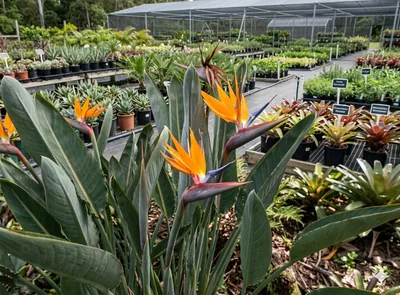
People use these two names interchangeably. They are relatives, not the same plant, and heliconia is sometimes literally sold as “false bird of paradise” because the bracts resemble the true bird of paradise (Strelitzia).
The quick tells:
| Heliconia | Bird of Paradise (Strelitzia reginae) | |
|---|---|---|
| The colourful part | Bracts in a row along a stem, often hanging | A single fan-shaped “bird’s head” bloom |
| Colours | Red, orange, yellow, pink | Orange and blue |
| Foliage | Banana-like, clumping, soft | Stiff, upright, paddle-shaped |
| Habit | Spreads by rhizome into a clump | Tight upright fan |
| Family | Heliconiaceae | Strelitziaceae |
If you want the hanging lobster-claw look, that is heliconia (H. rostrata). If you want the orange crane-head bloom, that is bird of paradise. We stock both, and we will match whichever look the design actually calls for. Ordering the wrong one is a common and expensive mistake, because you will not know until it flowers.
On Pets: What We Actually Know
Short version: nobody has assessed it, and we are not going to guess.
Heliconia is not on the ASPCA’s list of plants toxic to cats and dogs. That sounds reassuring, and a lot of plant listings would stop there and call it pet-safe. But heliconia is also not on the ASPCA’s non-toxic list.2 It appears on neither. No authority has cleared it, and no authority has flagged it.
“Not listed as toxic” and “confirmed safe” are different claims, and on a safety question that difference is the whole point. So our Quick Facts box says “Not assessed by the ASPCA” rather than “Yes.”
If you specifically need a flowering shrub that is confirmed non-toxic to cats and dogs, that is santan: the ASPCA lists Ixora coccinea as non-toxic to both dogs and cats.3 And if you want to know which of our plants is confirmed toxic, ti plant is, and we say so on its page.
Popular Varieties
Height is set by the variety, not by the size you buy. This is the single most useful thing to get right:
- Heliconia rostrata (Lobster Claw): hanging red-and-yellow bracts, 6-12 ft. The iconic one.
- Heliconia psittacorum (Parrot’s Beak): compact, 3-5 ft. Best for smaller spaces and mass colour.
- Heliconia caribaea: large upright bracts, 8-15 ft. Strong for screening.
- Heliconia wagneriana: dramatic red and green bracts, 10-15 ft.
A large clump of psittacorum will never screen a fence, however long you wait. Choose the variety for the finished height.
Growing Requirements
- Sun: filtered light to partial shade. Direct harsh sun burns the leaves and dulls the bract colour. Morning sun with afternoon shade, or a high dappled canopy, is ideal.
- Water: high, and this is the plant’s real demand. Heliconias need consistent moisture and struggle in dry conditions. Do not plant them on a lot you cannot irrigate.
- Soil: rich, well-drained, high in organic matter.
- Space: the clumping habit spreads by rhizome, roughly 30-60 cm a year. Plan for the mature width, not the planted width.
Important Considerations
- Water needs: heliconias struggle in dry conditions. This is not a plant for an unirrigated lot.
- Space: clumps spread. Plan for mature size or plan to divide.
- Cold: sensitive to cold snaps. Rare in the lowlands, real at Tagaytay elevation.
- Debris: it creates leaf litter that needs cleaning up.
Landscape Uses
- Tropical garden colour accent
- Privacy screening with the taller varieties
- Poolside planting
- Understory planting beneath palms
- Cut-flower production
Size & Pricing
Plant material only, priced per division or per clump, not per stem:
| Size / Type | Height | Price |
|---|---|---|
| Small divisions | varies by variety | ₱200 - ₱500 |
| Established clumps | varies by variety | ₱500 - ₱1,000 |
| Large specimens | varies by variety | ₱1,000 - ₱2,000 |
Prices vary by variety, and rare varieties command higher prices. Height is set by the variety you pick, not by the tier you buy.
Care Tips
- Keep the soil consistently moist, and mulch heavily to hold moisture.
- Fertilize monthly with a high-nitrogen fertilizer.
- Remove spent flower stalks at the base.
- Divide clumps every 3-4 years to keep them vigorous. A crowded clump flowers poorly.
Sources
Footnotes
-
Kew’s Plants of the World Online / World Checklist of Vascular Plants, genus Heliconia L., the sole genus in the family Heliconiaceae. Native to the tropical Americas, with a small number of species in the western Pacific; nectar-rich flowers are a key food source for hummingbirds in the native range. Accessed 2026. https://powo.science.kew.org/taxon/urn:lsid:ipni.org:names:331205-2 ↩
-
ASPCA, Toxic and Non-Toxic Plants list. Heliconia appears on neither the toxic nor the non-toxic list, checked against the “H” index (which does list Hawaiian Ti as toxic). Its absence is therefore an absence of assessment, not a clearance. Accessed 2026. https://www.aspca.org/pet-care/animal-poison-control/toxic-and-non-toxic-plants ↩
-
ASPCA, Toxic and Non-Toxic Plants list, “Iron Tree (Ixora coccinea),” also listed as Flame of the Woods. Non-toxic to dogs and non-toxic to cats. Accessed 2026. https://www.aspca.org/pet-care/animal-poison-control/toxic-and-non-toxic-plants/iron-tree ↩
We plant and install this
Halamanan supplies and installs Heliconia as part of our landscape design and landscape construction projects. We source the plants, place them in the design, and plant them with the rest of the garden.
Sourcing & Supply
Origin
Sourced from Luzon growers as divisions and established clumps. Rarer varieties (wagneriana, coloured caribaea cultivars) are sourced to order and priced higher.
Supplier Relationship
Working relationships with growers carrying the common landscape varieties year-round. Rare varieties move in and out of production, so a specific cultivar is worth confirming early rather than assuming.
Quality Control
Screening runs are matched by variety and clump size so a run of caribaea fills evenly. We confirm variety on colour-specific orders, and this genuinely matters here: a young heliconia clump has not thrown a bract yet, so it does not show its colour, and mislabelled stock is common in the trade. You cannot check it by eye on delivery, which is exactly why we check it at the grower.
Frequently Asked Questions
How much does Heliconia cost in the Philippines?
Small divisions run ₱200 to ₱500, established clumps ₱500 to ₱1,000, and large specimen clumps ₱1,000 to ₱2,000. Rare varieties (red wagneriana, coloured cultivars) command higher prices. Pricing is per division or per clump, not per stem.
What is the difference between heliconia and bird of paradise?
They are related but different plants, in different families. Heliconia carries its bracts in a row along a stem, often hanging like a lobster claw, on banana-like clumping foliage. Bird of paradise (Strelitzia reginae) carries a single fan-shaped orange-and-blue 'bird's head' bloom on a stiff upright stalk with paddle leaves. Heliconia is sometimes sold as 'false bird of paradise' precisely because of the resemblance. If you want the hanging claw, order heliconia. If you want the crane head, order bird of paradise.
Is Heliconia safe for pets?
We do not know, and we would rather say so than guess. Heliconia is not on the ASPCA's list of plants toxic to cats and dogs, but it is also not on their non-toxic list, so no authority has actually assessed it either way. 'Not listed as toxic' is a weaker statement than 'confirmed safe', and on a safety question the difference matters. If you need a flowering shrub that is confirmed non-toxic to cats and dogs, santan (Ixora coccinea) is listed by the ASPCA as non-toxic to both.
Is Heliconia pool safe?
Yes. Heliconias produce no fruit drop, leaf drop is manageable, and roots are non-aggressive toward pool structures. Plant 2 to 3 m from the pool edge to keep leaf fall off the deck.
How fast does Heliconia grow?
Fast. Established divisions reach mature flowering size in 9 to 18 months in Philippine lowland conditions, given consistent water and rich soil. The clump spreads laterally roughly 30 to 60 cm per year, so plan for the mature width rather than the width you plant.
Does Heliconia need full sun?
No, and this is where people get it wrong. Most varieties prefer filtered light to partial shade. Direct harsh sun burns the leaves and dulls the bract colour. Plant under a high canopy, or on the east side of a structure for morning light only.
Which Heliconia variety is best for screening?
For privacy screening, Heliconia caribaea and Heliconia wagneriana reach 8 to 15 ft and form dense clumps. Heliconia rostrata (Lobster Claw) reaches 6 to 12 ft with the iconic hanging bracts. For shorter accents and mass planting, Heliconia psittacorum stays at 3 to 5 ft. Choose the variety for the height you want, because the tier you buy does not set the final height.
Why is my heliconia not flowering?
Usually water or light. Heliconia needs consistent moisture and will sulk in dry soil, and it flowers poorly in deep shade as well as in harsh full sun. Filtered light plus steady water is the combination. A clump that has not been divided in years can also crowd itself into poor flowering, so divide every 3 to 4 years.