Eugenia (Red Top)
Syzygium myrtifolium
Also known as: Red Top, Red Lip, Pucuk Merah
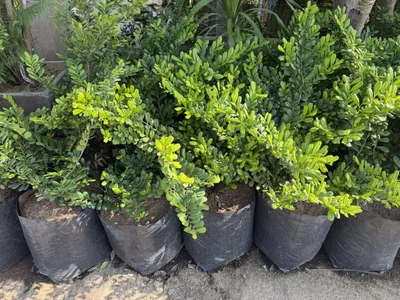
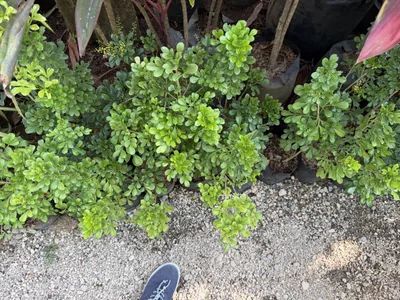
The dense privacy hedge with the signature red-orange new growth, seen topping walls across Laguna and Cavite villages. Botanically Syzygium myrtifolium; the trade name 'Eugenia' is a leftover from its old botanical name, Eugenia oleina. Every trim triggers a fresh red flush. Genuinely native to the Philippines per Kew, which makes it one of the very few premium hedge plants here that is defensible on a native-spec brief. ₱500 to ₱1,500 per plant.
Pricing Guide (per plant)
| Size / Spec | Price (PHP) |
|---|---|
| 4-5 ft | ₱500 |
| 6-8 ft | ₱1,500 |
Volume Discounts
- 50+ plants:Volume pricing on perimeter hedge runs, quoted per linear meter
Plant material only. Perimeter hedge runs, soil preparation, and planting are quoted per linear meter based on site conditions and access. Bulk quantities are sourced to order. On hedge runs we match plants for height and fullness so the line closes evenly, because one gappy plant in a straight row is the thing you will look at every day.
Request Project Quote →About Eugenia (Red Top)
Drive through any upmarket village in CALABARZON and you will see eugenia hedges: dense green walls topped with a glowing flush of red-orange new leaves. That flush is the plant's signature, and it reappears every time the hedge pushes new growth after a trim, which makes trimming both shaping and colour management. The trade calls it 'Eugenia' because that was its botanical name for years, Eugenia oleina. Botanists have since moved it into the genus Syzygium, so the accepted name today is Syzygium myrtifolium, but the old name stuck to the plant in the nursery trade. Abroad it sells as 'red lip' or, in Malaysia and Indonesia, 'pucuk merah' (red shoots). Here is the part worth stating plainly: eugenia is genuinely native to the Philippines. Kew's World Checklist of Vascular Plants lists the Philippines within its native range, with records from Luzon, Mindoro, Sibuyan, Bohol, and Palawan. Unlike almost every other premium hedge plant sold here, this one is defensible on native-spec and biodiversity briefs.
Common Applications
- Perimeter privacy hedges. The default premium screening hedge in PH subdivisions and villages. Planted 45-60 cm on-center.
- Formal clipped hedges and topiary. Takes shearing well and buds back densely, so it holds cones, balls, and spirals.
- Streetscape and frontage planting. Common along commercial frontages and subdivision common areas where a hedge has to look maintained.
- Wall-top and boundary screening. Planted along walls to add height and soften a hard boundary without the cost of a taller wall.
- Butterfly and pollinator planting. The powderpuff flowers draw butterflies and bees, and the fruit brings birds.
- Native-spec and biodiversity briefs. One of the few premium hedge plants in the PH trade that is genuinely native, so it survives a native-planting requirement.
Where You'll See It
- Laguna and Cavite village perimeter hedges
- Subdivision common areas and streetscapes
- Commercial and office frontages
- Formal clipped hedges and topiary in premium gardens
- Wall-top boundary screening
- Resort and clubhouse boundary planting
Why Architects Choose It
- Genuinely PH-native per Kew, which supports native-spec and biodiversity briefs
- Fast to establish, so a perimeter reads as a real hedge within 12 to 18 months
- The red flush gives seasonal colour movement without a flowering bed to maintain
- Trims clean and dense, holding a formal wall or a topiary shape
- Dense from the ground up, so it screens at knee height as well as at eye height
- Pollinator value from the powderpuff flowers
Project Types Best Suited
- Subdivision and village perimeter hedging
- Premium residential boundary planting
- Commercial frontage and streetscape
- Formal garden and topiary work
- Native-spec and biodiversity planting
- Resort and clubhouse grounds
Specifications
- Botanical name
- Syzygium myrtifolium Walp.
- Family
- Myrtaceae (myrtle family)
- Synonyms
- Eugenia oleina Wight (the source of the trade name); Syzygium sinubanense (Elmer) Diels; Eugenia myrtifolia Roxb.
- PH trade names
- Eugenia, Red Top
- Native range
- Bangladesh through mainland and western Malesia, including the Philippines (Luzon, Mindoro, Sibuyan, Bohol, Palawan)
- Status in PH
- Native species per Kew's World Checklist of Vascular Plants, the dataset behind Plants of the World Online
- Habit
- Evergreen shrub or small tree; dense from the ground up
- Height
- 5-9 m untrimmed; held at any hedge height in cultivation, commonly 1 m to 2.5 m
- New growth
- Red to red-orange flush on every new push, maturing to glossy green. Each trim triggers a fresh flush
- Flowers
- Powderpuff, cream to white, fragrant; attract butterflies and bees
- Fruit
- Small, reddish-purple ripening to black; attracts birds
- Sun
- Full sun for the strongest red flush; tolerates light shade, but the colour fades and the hedge thins
- Water
- Medium to high. Regular water until established, then moderate, with support through the dry season
- Soil
- Adaptable. Prefers well-drained, fertile soil
- Growth rate
- Fast. Responds quickly to trimming
- Trimming
- Every 4-8 weeks in the growing season. Each cut is both shaping and colour management
- Spacing
- 45-60 cm on-center for a dense perimeter hedge
- Pool safe
- Yes. Dense, low-litter foliage
Eugenia (Red Top) Hedge Supplier in the Philippines
Drive through any upmarket village in CALABARZON and you will see it: a dense green wall topped with a glowing flush of red-orange new leaves. That is eugenia, and the flush is its whole signature. It comes back every time the hedge pushes new growth after a trim, which means trimming is not just shaping, it is colour management.
Botanically it is Syzygium myrtifolium. We supply it at ₱500 to ₱1,500 per plant, matched for height and fullness on perimeter runs.
Why It Is Called “Eugenia” When It Is Not a Eugenia
The name is a fossil. For years the plant’s botanical name was Eugenia oleina, and that is the name the nursery trade learned it by. Botanists have since moved it into the genus Syzygium, so the accepted name today is Syzygium myrtifolium and Eugenia oleina is filed as a synonym.1
The trade never caught up, and there is no reason it should. Everyone in the PH landscape business calls it eugenia, so that is what we call it too. Just know that if you look it up under Eugenia you will end up at Syzygium.
Abroad, the same plant sells as “red lip” or, in Malaysia and Indonesia, “pucuk merah” (red shoots).
The Native-Species Angle (This One Is Real)
Here is the part worth stating plainly, because it is unusual: eugenia is genuinely native to the Philippines.
Kew’s World Checklist of Vascular Plants, the dataset that Plants of the World Online is built on, lists the Philippines within the native range of Syzygium myrtifolium, with no introduced flag against it.1 Catalogue of Life records it down to the island level: Luzon, Mindoro, Sibuyan, Bohol, and Palawan.2 Philippine botanical records also carry it under the old synonyms Eugenia oleina and Eugenia sinubanensis, which is exactly the kind of trail a long-recorded native leaves behind.
Why that matters commercially: almost every premium hedge plant in the PH trade is an import. Maki is East Asian. The garden santans are Indian, Thai, and Chinese. If a project brief carries a native-planting requirement, most of the good hedging options fail it on the spec sheet.
Eugenia passes. It is fast, it is premium, it looks maintained, and it is native. That combination is rare, and it is the reason to specify it over the alternatives when a biodiversity brief is in play.
Common Applications
- Perimeter privacy hedges. The default premium screening hedge in PH villages, planted 45-60 cm on-center.
- Formal clipped hedges and topiary. Takes shearing well and buds back densely, so it holds cones, balls, and spirals.
- Streetscape and frontage. Common along commercial frontages and subdivision common areas.
- Butterfly and pollinator planting. The cream powderpuff flowers draw butterflies and bees; the black fruit brings birds.
Growing Conditions in the Philippines
- Sun: full sun gives the strongest, most reliable red flush. In shade it still grows, but the colour fades and the hedge thins from the bottom.
- Water: medium to high. Regular water until established, then moderate, with support through the dry season.
- Soil: well-draining and fertile. Amend with compost at planting to speed up closure.
- Trimming: every 4-8 weeks in the growing season. Each cut triggers a fresh red flush.
- Spacing: 45-60 cm on-center for a dense perimeter hedge.
Eugenia vs Maki: The Real Hedging Decision
In PH premium hedging, the choice usually comes down to these two:
| Eugenia (Red Top) | Maki (Podocarpus) | |
|---|---|---|
| Growth | Fast, closes in 12-18 months | Slow, roughly 15-30 cm per year |
| Look | Soft, colourful, red flush | Formal, architectural, dark green |
| Trimming | Every 4-8 weeks | Two or three light shearings a year |
| Price | Cheaper per plant | Premium, you pay for the grower’s years |
| Native to PH | Yes | No, it is an East Asian import |
Pick eugenia when you want a boundary to close fast, you want colour, and you do not mind maintaining it. Pick Maki when you want a crisp formal wall that holds its shape and you can pay for it.
Pricing
Plant material only:
| Size | Price |
|---|---|
| 4-5 ft | ₱500 |
| 6-8 ft | ₱1,500 |
Perimeter hedge runs, soil preparation, and planting are quoted per linear meter based on site conditions and access. Bulk quantities are sourced to order.
Care Highlights
- Trimming: every 4-8 weeks in the growing season. This is what drives the red flush.
- Feeding: a balanced fertilizer keeps the flushes coming. A hedge that stops flushing is usually hungry, shaded, or overdue a cut.
- Water: regular, and do not let it dry out through the dry season.
- Base density: trim early while the plants are short. It forces low branching, which is what stops the hedge going leggy at the bottom.
Sources
Footnotes
-
World Checklist of Vascular Plants (WCVP), Royal Botanic Gardens, Kew, the dataset behind Plants of the World Online. Syzygium myrtifolium Walp., accepted; native distribution includes the Philippines (alongside Bangladesh, Myanmar, Thailand, Malaya, Sumatra, Borneo, and Java). Synonyms include Eugenia oleina Wight and Syzygium sinubanense (Elmer) Diels. Accessed 2026. https://powo.science.kew.org/taxon/urn:lsid:ipni.org:names:60445221-2 ↩ ↩2
-
Catalogue of Life, distribution record for Syzygium myrtifolium Walp., giving Philippine island-level records: Palawan and the Philippines (Luzon, Mindoro, Sibuyan, Bohol). Accessed 2026. https://www.gbif.org/species/3183420 ↩
We plant and install this
Halamanan supplies and installs Eugenia (Red Top) as part of our landscape design and landscape construction projects. We source the plants, place them in the design, and plant them with the rest of the garden.
Sourcing & Supply
Origin
Sourced as bagged and field-grown stock from Luzon growers, from hedge starters up to instant-screen specimens.
Supplier Relationship
Working relationships with multiple hedge growers. Large runs are coordinated across yards when single-source stock is short, which is common on eugenia because perimeter orders tend to be large and arrive all at once.
Quality Control
Perimeter runs are matched for height and fullness so the hedge closes evenly. A straight line of hedge is unforgiving: one thin or short plant in a row of thirty is the thing the client notices first, and it stays visible for a year. We grade the run before it ships rather than after it is planted.
Frequently Asked Questions
What is Eugenia / Red Top?
It is a dense evergreen hedge plant, botanically Syzygium myrtifolium, known for the red-orange flush on its new growth. The trade name 'Eugenia' is a leftover from its old botanical name, Eugenia oleina. 'Red Top' refers to that red new growth sitting at the top of the plant. It is the default premium privacy hedge in Philippine villages.
Is eugenia really native to the Philippines?
Yes. Kew's World Checklist of Vascular Plants, the dataset behind Plants of the World Online, lists the Philippines within the native range of Syzygium myrtifolium, with records from Luzon, Mindoro, Sibuyan, Bohol, and Palawan. Philippine botanical records also carry it under the old names Eugenia oleina and Eugenia sinubanensis. That native status is unusual among premium hedge plants here, and it makes eugenia defensible on native-spec and biodiversity briefs where imported hedges are not.
Why is my eugenia not turning red?
The red only ever shows on new growth, so a hedge that has stopped flushing has usually stopped growing. It normally needs one of three things: a trim, more sun, or feeding. Trim it lightly, move it into more sun if you can, apply a balanced fertilizer, and fresh red leaves should follow within a few weeks. A hedge sitting in shade will stay green and thin out.
How fast does eugenia grow?
Fast for a hedge plant, and it responds quickly to trimming. A hedge planted from 4-5 ft stock typically reads as a real hedge within about 12 to 18 months under good conditions. That speed is the main trade-off against Maki, which is slower but holds its shape far longer.
How far apart should eugenia be planted?
About 45-60 cm on-center for a standard dense perimeter hedge. Closer spacing with smaller plants fills in faster and costs less per plant, but you buy more plants, so the cost per linear meter lands in a similar place.
How big does eugenia get if I do not trim it?
Left alone it grows into a small tree, roughly 5-9 m tall. As a hedge it will hold any height you keep it at, from a 1 m border to a 2.5 m privacy wall. It does need to be kept at that height, though: eugenia is fast, and an untrimmed 'hedge' becomes a row of small trees.
Is eugenia the same as 'pucuk merah'?
Yes. 'Pucuk merah' (red shoots) is the Malay and Indonesian name for the same plant, Syzygium myrtifolium. 'Red lip' is another common English trade name for it. All three names describe the same red new growth.
Eugenia or Maki: which should I use for a hedge?
Eugenia is fast, colourful, and cheaper; Maki is slow, formal, and holds its shape for months. Pick eugenia when you want a boundary to close quickly and you do not mind trimming it every 4-8 weeks. Pick Maki when you want a crisp architectural wall with minimal maintenance and you can pay for the grower's time. See our Maki page for the direct comparison.