
Garden Privacy Ideas for Small Philippine Lots
Privacy for small PH lots without the prison-wall look: solid CHB, breeze block screens, and living fences compared, with costs, permit rules, and plant pairings.
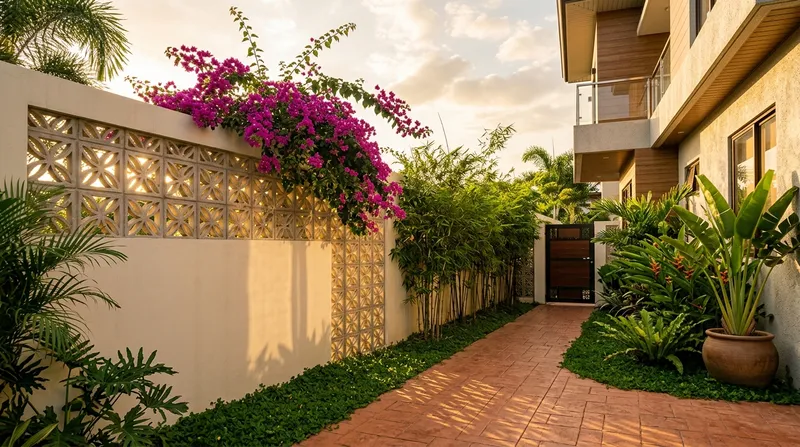
Most of the lots we work on in Laguna and Cavite are between 80 and 150 square meters. By the time the house is built, the garden is a strip: three meters at the front, maybe a meter and a half at the side, and a service area at the back. Then the neighbor’s second-floor window goes up, and suddenly the number one request we get is not plants. It is privacy.
The default answer in the Philippines is a full-height concrete hollow block wall, plastered, painted, done. It works. It is also why so many subdivision gardens feel like exercise yards. You get privacy and lose light, airflow, and any sense that the space is a garden at all.
There are better options, and most of them cost less than people expect. Here is how we think through it on actual projects.
Start with what the wall is actually for
Privacy is not one problem. On small lots it usually breaks into three separate ones:
- Sightlines from the street or the gate into your garden or sala
- Sightlines from a neighbor’s window or terrace looking down into your lot
- The feeling of enclosure, which is about comfort, not visibility
A solid 1.8-meter wall solves the first. It does almost nothing for the second, because the neighbor’s window is at four meters and your wall tops out below two. And it often makes the third worse, because a small space surrounded by solid concrete feels smaller.
Once you separate these, you stop defaulting to “taller wall” and start matching the fix to the sightline.
The solid CHB wall, honestly
The plain concrete hollow block wall is still the right answer in some cases. If your lot faces a busy through-road, or security is the genuine concern in your area, build solid. You can soften it afterward: a painted CHB wall is the best backdrop a garden can ask for, and a row of plants against it hides most of its bulk.
The downsides show up on small lots specifically. A solid wall on the west or south side blocks the breeze exactly where you need it in April and May. It casts hard shade that limits what you can plant along it. And it traps heat: concrete absorbs sun all day and radiates it back into your garden until late evening.
One rule worth knowing before you pour anything: under the National Building Code (PD 1096) and its Revised IRR, a fence up to 1.80 meters is covered by a simple fencing permit, while anything taller falls into a different classification and needs the full building permit route. On top of that, most subdivisions have their own deed restrictions on fence height and materials, and some HOAs require the front fence to be partly see-through. Check your deed restrictions and your local Office of the Building Official before committing to a design. Rules vary by LGU, and a barangay-level dispute over a wall is not something you want to fund.
Where breeze blocks change the math
Breeze blocks (ventilation blocks, decorative blocks, whatever your supplier calls them) are the middle option most homeowners forget exists, even though half the houses built in the 60s and 70s in this country used them.
A breeze block screen gives you roughly 40 to 60 percent visual blockage depending on the pattern, while letting air and dappled light through. From the street, at an angle, a patterned screen reads as nearly solid. Straight on, up close, it reads as open. That angle-dependent privacy is exactly what a garden wall facing a sidewalk needs: passersby moving along the street never get a clean line of sight, but your garden still breathes.
Where we use them most:
- The top third of a wall: solid CHB up to 1.2 meters for security, breeze blocks above that for light and air
- Screening a garage or carport from the garden
- Dirty kitchen and laundry area walls, where you need airflow by design anyway
- Pool and terrace screens, where a solid wall would kill the breeze
That last one matters more than people expect. Our pool landscaping guide goes deeper on screening a pool without walling off the air.
On cost: expect somewhere between ₱110 and ₱400 per block from vetted suppliers depending on size and pattern, before laying. You will see marketplace listings as low as ₱40 to ₱90 per piece, and some of those are fine, but under-cured blocks chip at the edges and vary in dimension, which shows badly in a screen wall where every unit is visible. If you are pricing a project, our breeze block price list has current per-piece prices, sizes, and coverage, and Groundwork’s breeze block guide documents the wider price range and patterns across suppliers, which is what we send clients before we quote.
One installation note from experience: dry-lay at least one full course before mortar. Breeze blocks from small casting yards can vary a few millimeters per piece, and in a screen wall the pattern makes every misalignment visible.
Plants do the second job
The neighbor’s second-floor window is a plant problem, not a wall problem. No legal fence height reaches it, so you block the sightline with height from vegetation instead.
For narrow strips, we use clumping bamboo most often. It gets you three to five meters of screening in a footprint of less than a meter, and clumping varieties stay where you plant them, unlike running bamboo, which will find its way under your neighbor’s pavement and turn into a barangay complaint. Golden duranta and podocarpus work as slower, tidier hedges where you have a bit more width.
Bougainvillea trained on a trellis or steel frame is the classic answer for the top of a wall, and it earns the cliché. It takes full sun, blooms hardest when you neglect it, and adds a meter or more of screen above your legal wall height because a plant is not a fence.
The pairing that works hardest is plants plus breeze blocks. Vines like cadena de amor thread through the openings and turn a screen wall into a green wall over one season. At the base, a ground cover such as peanut grass keeps the strip green with almost no maintenance, and in the shaded gaps behind the screen, ferns like the sinampalok fern do well where lawn grass would give up. If the strip is too narrow even for that, a vertical garden mounted on the wall itself gives you the green without the floor space.
What we would actually build on a 100 sqm lot
If you asked us to design privacy for a typical inner-lot house in Santa Rosa or Nuvali, the answer is usually a combination, not a single material:
Front: CHB base to about 1.2 meters, breeze block screen to 1.8, bougainvillea on a frame above the gate side. You keep street security, the facade stays open, and the garden gets afternoon breeze.
Side facing the neighbor’s window: clumping bamboo in a 60 to 80 centimeter planting strip, or a vertical garden panel if the strip is narrower than that.
Service area: full breeze block wall. The laundry needs the airflow, and it is the cheapest place to let the material do two jobs.
Total cost depends on runs and site conditions, so treat any per-linear-meter figure you see online with suspicion, including ours. For a sense of how the numbers stack up across a whole garden, our landscaping cost guide breaks down the typical ranges. Get the pattern and block size decided first, because that drives both the price and the look, then quote the masonry.
Before you build anything
Three checks, in order: your subdivision deed restrictions, your LGU’s fencing permit requirements, and a conversation with the neighbor if the wall sits on a shared boundary. Shared boundary walls need written agreement, and fence disputes go through the barangay before they can go anywhere else. Thirty minutes of paperwork reading is cheaper than redoing a wall.
Then decide what you are actually blocking: the street, the window, or the feeling. The answer is usually not a taller wall. It is usually a shorter wall with better ideas on top of it.
Halamanan designs and builds gardens across Laguna, Cavite, and Metro Manila, including screen walls and hardscape, softscape, and vertical gardens. Send us your lot dimensions and we will tell you what we would do with the space.
Ready to Start Your Project?
Get a free consultation and estimate for your landscape project.
Get Your Free Estimate